
Confirmation bias in tarot: do you recognise it?
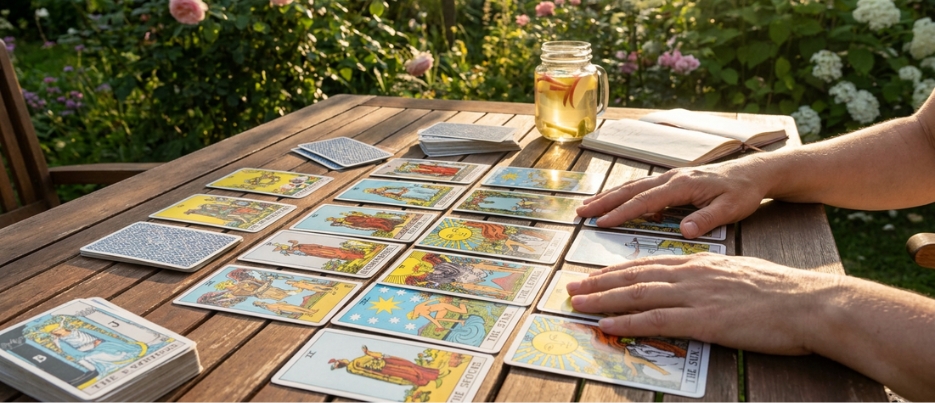
You probably know the feeling. You ask the cards a question, draw one, and the answer does not sit right. So you draw another. And another. Until something lands that feels like confirmation of what you already thought or hoped. Then you put the cards away and call it a reading.
That is not a reading. That is confirmation bias.
And there is no shame in it. Almost everyone who reads tarot does it at some point. But it helps to recognise it, because as long as you cannot see it, you are quietly steering yourself in the wrong direction.
What confirmation bias actually is
Confirmation bias is the tendency of the human mind to seek, interpret, and remember information in a way that confirms what it already believes. It is not a weakness or a lack of intelligence. It is a basic pattern of how the brain works, and it affects everyone.
In tarot it can show up in several ways:
Drawing until it fits
You pull card after card until you find one that says what you wanted to hear. The earlier cards “did not count” or you explain them away as noise. The last card was the real one.
Selective interpretation
You draw the Tower but read it as “a necessary change that turns out well” rather than “something is breaking down”. Not because that reading is impossible, but because in that moment it was exactly the reading you needed.
Asking the same question again
The answer was clear but unwelcome, so you ask the same question tomorrow, rephrased, with the same deck, with a different deck. Until the answer changes. But the question was the same.
Only remembering the good cards
Last week you drew three difficult cards and one positive one. The positive one is still clear in your mind. The other three you have forgotten.
Why it is so hard to recognise
Confirmation bias does not feel like deception. It feels like understanding. When you interpret a card in a way that fits what you already believe, there is a sense of recognition and relief. That feels good. It feels like insight.
On top of that, tarot cards are broad enough to connect to almost anything. A skilled reader can read the Tower as liberation. A skilled reader can read the Sun as blindness to reality. That flexibility is one of tarot’s strengths, but it also makes confirmation bias easier to hide.
It is not the card that deceives you. That is something you do yourself.
What helps
Write down your question before you draw
Literally, on paper. That fixes it in place and means you cannot quietly adjust it afterwards to fit the card you got. It is one of the simplest and most effective things you can do.
One draw per question, per day
One card per question, per day. No more. If you feel the urge to draw another for “more context”, ask yourself first: am I not accepting the answer, or do I genuinely not understand it? Those are two very different things.
Write your interpretation before thinking about what you hoped for
Turn the card over. Write two sentences about what you see, before you think about what you were hoping for. Only then bring in the context. That order makes a significant difference.
Wait a day before asking the same question again
If you do not like the answer, wait at least 24 hours before asking the same question again. Not to forbid the question, but to let the emotion settle. Tomorrow you will look with different eyes.
And if you do it anyway?
Then you did it. It is not a disaster. Confirmation bias is human and knowing about it does not make it disappear. What helps is naming it in the moment: “I am drawing again because the answer did not suit me.” That small act of honesty is often enough to stop.
The longer you practise this, the better you get at knowing when you are drawing from curiosity and when from fear. Our top 10 frequently asked questions about tarot touches on some of the common traps readers fall into, including this one. And if you want to practise looking at what you normally skip in a reading, the yearly spread is a useful structure for staying honest over time: yearly tarot spread: a journey through time.
Tarot works best when you are willing to hear what you did not expect. That takes practice. But it starts with being honest about when you would rather not.
Looking for a deck that challenges you to look honestly? Browse the full range at tarot.nl.