Tarot and ChatGPT: what the research says about readers
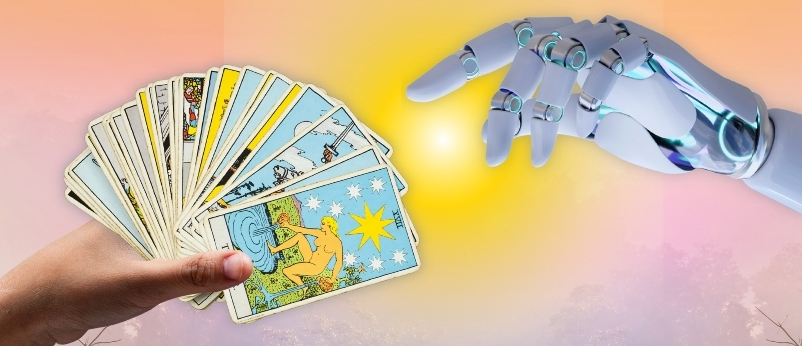
Tarot and ChatGPT: where is the line?
Do you ever doubt your own reading of a card so much that you combine tarot and ChatGPT?
You draw a card and suddenly you are not sure any more. Is this what I think it is, or am I just seeing what I want to see? Some readers type the card into a chatbot at that moment. In 2026, researchers asked 12 of them why. Their answers are very familiar, even if you are still learning yourself.
What does research say about tarot and ChatGPT?
The study is small. All 12 readers already worked with AI, so it tells us something about them and not about everyone who reads tarot. The researchers themselves call it a first exploration. Still, the stories give a good picture of what happens when a chatbot looks along at a spread.
Why readers turn to a chatbot
The most common reason is doubt. A man who has worked on his own system for more than 30 years said he still second-guesses himself. Am I overthinking this, or not thinking enough? Am I putting too much of myself into the card? A chatbot helped him sort out his thoughts.
Another reader asks ChatGPT for 3 different explanations of the same spread. Then they read them one by one and see which one fits the situation, even if it is not the explanation they thought of first.
And then there is time. A full reading can take 30 minutes to an hour. If your diary is full, a chatbot is a quick route.
The worries: a chatbot that agrees and intuition that fades
The same readers also had worries. They wondered whether a chatbot agrees too quickly with the person asking the question. If you hope for a certain answer, you may be told exactly that, even when the cards show something else. And they feared that their own intuition would fade if they always ask a chatbot first.
“A chatbot does not know your question, your day or what you see in the picture.”
That is our own thought and not a result of the study. A chatbot can offer words that fit a card. The story behind that card, you have to tell yourself.
How sensitive this is, the researchers noticed themselves. When they looked for participants through online tarot groups, more than 70% of the replies were refusals, often because of AI.
What this means if you are learning to read tarot yourself
There is no right or wrong. One reader finds a chatbot a pleasant conversation partner, another wants nothing to do with it. It does help to keep 2 things apart. Looking up a meaning can be done by a booklet, and a chatbot can do that too. Reading a spread is your job: you make the links between the cards.
Does a figure look toward another card? Does the same colour or detail come back in the spread? You see that with your own eyes. If you only type the card names into a chatbot, those images are no longer part of it. That is where your work as a reader lies.
- You first: write down what you see in the card yourself, before you ask anyone or any chatbot.
- Look up and connect: let help give you a meaning, and make the links between the cards yourself.
- Notice the tone: does the explanation mostly confirm what you hoped for? Then the chatbot may simply be agreeing with you.
- Choose on purpose: use help as a second opinion, not as the first answer.
Are you more interested in decks that were made with AI? That subject is covered in our blog on AI tarot decks.
About the study: the 12 participants came from the United States, Canada and Mexico. The study was presented in April 2026 at the CHI conference in Barcelona. Source: Interpretive Cultures: Resonance, randomness, and negotiated meaning for AI-assisted tarot divination by Matthew Kieran Prock, Ziv Epstein and colleagues. Summaries can be found at Study Finds and Vice.
Want to keep learning?
Get our free guide and learn how to draw a card every day and which deck really suits you.
Get the guideWant to learn more about reading by instinct? These blogs are a good next step:
Looking for a deck to practise with? Have a calm look at the beginner decks.