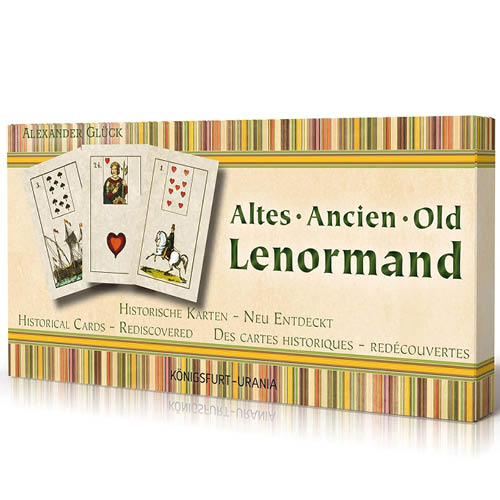
Old Lenormand - reproduction of a 19th-century deck
Not every historical deck has survived well enough to be reprinted. This one from around 1850 has. Alexander Glück reproduced it with attention to detail: square corners, the same colours, the same iconography.
The result is a deck that feels like an antique heirloom but comes fresh from the box. No restored scan with stains or fading. Just clearly printed, on solid cardstock.
What you see on the cards
The symbolism is classic Lenormand: ship, house, snake, ring, all drawn in mid-19th-century style. No ornamental borders or extra decoration. The focus lies entirely on the symbol itself.
The colours are muted: earthy tones, pale red, blue and green. That matches the period when the original was made. It does not feel polished, and that is exactly the point.
The cards have square corners. That sounds like a detail, but it significantly strengthens the antique feel. Rounded corners only became common later.
Why this format works
The cards are compact: 44 x 75 mm. That is smaller than a standard playing card. For anyone who likes laying out a Grand Tableau, that is an advantage. You need less space and can arrange all 36 cards clearly, even on a desk or coffee table.
The cardstock is sturdy enough for daily use. The cards do not bend easily and feel solid when shuffling.
Place this deck next to a modern Lenormand once. The difference in atmosphere is immediately visible. Not better or worse, just different.
About Alexander Glück
Alexander Glück specialises in historical card reproductions. His work is characterised by precision: he reproduces not only the image, but also the printing technique and colour palette of the original edition.
Specifications
- Number of cards: 36
- Card size: 44 x 75 mm
- Corners: Square
- Cardstock quality: Sturdy cardstock
- Guidebook: Trilingual (German, English, French)
- Publisher: Königsfurt-Urania Verlag
- ISBN: 9783868267723
- Reproduction of: Lenormand deck circa 1850
Questions we often get
Is the guidebook available in other languages besides German, English and French?
No. For those already familiar with Lenormand, the cards themselves are sufficient. The symbolism is universal.
How does this deck differ from a modern Lenormand?
The style is 19th-century: muted colours, no decoration, square corners. Modern decks often have brighter colours and extra details. This deck sticks to the essentials.