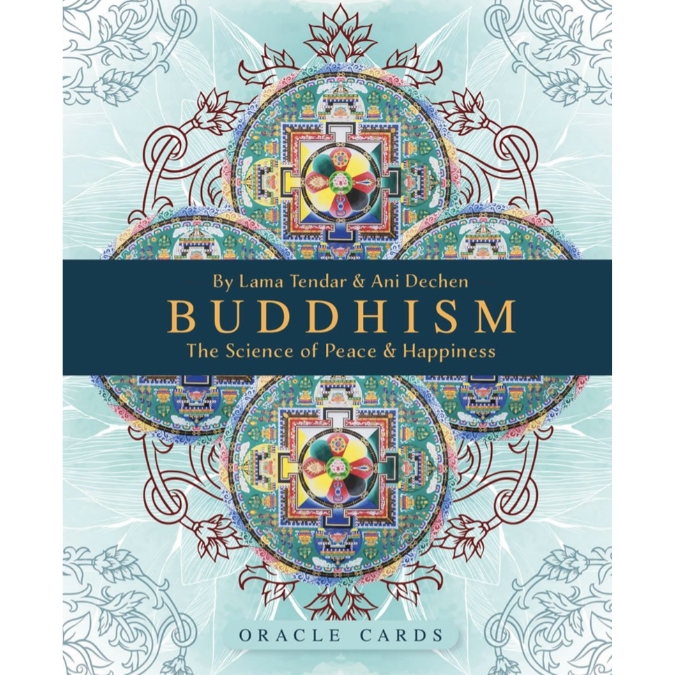
Buddhism: The Science of Peace & Happiness Oracle - Tibetan Buddhism in 52 round cards
Most oracle cards draw from Western esoteric traditions, astrology, or intuitive symbolism. This deck takes a different route. Buddhism: The Science of Peace & Happiness Oracle is built on the teachings of Tibetan Buddhism, and its creators treat those teachings as a practical system rather than a religious experience.
The two people behind this deck have concrete credentials. Lama Tendar became a Tibetan Buddhist monk at the age of twelve, trained for eight years at Gyuto Ramoche Monastery in Lhasa, and continued for another sixteen years at Gyuto Monastery in India. Ani Dechen holds a PhD in Economics of Development from the Australian National University, studied Buddhism under Lama Tendar, and was ordained as a Buddhist nun in 2017. Both now live and work in Australia.
What the cards offer
The deck contains 52 round cards, each carrying a message rooted in centuries of Buddhist wisdom. The full-colour guidebook goes into the background of each card and focuses on practical application: how to bring these insights into everyday life, into how you respond to setbacks, to others, and to yourself.
The cards are finished with gold foil and have a calm, settled visual tone. The round format is a deliberate departure from the standard rectangular shape. They feel different in the hand, and there is no fixed top or bottom edge to orient around.
What sets this deck apart
Most Buddhist-inspired oracle decks translate Buddhist imagery for a Western audience through symbolism or atmosphere. This one takes a more direct approach. The creators describe their method as scientific, meaning: no requirement of belief, but observation, understanding, and application. Whether you follow Buddhism or not, the cards address universal themes including compassion, clarity, and how to meet uncertainty.
That changes how you use it. You draw a card, read the accompanying text, and consider how the teaching applies to what is happening in your life right now.
This deck works best with the guidebook open alongside it. The cards are visually compact; the depth sits in the text.
About Lama Tendar and Ani Dechen
Lama Tendar received his first Buddhist instruction at twelve years old. After his training in Lhasa and India, he moved to Melbourne in the early 2000s, where he has since been teaching Buddhist Dharma and providing healing for individuals and community groups. He founded the Medicine Buddha Tantrayana Meditation Centre and the Shantideva Buddhist Foundation.
Ani Dechen has an academic background in development economics. She came to Buddhism through Lama Tendar after earlier studies in Reiki healing, and combined her two worlds in her work as a natural healing therapist. Caring for her father, who died in 2011, shaped her decision to study Buddhist practice more deeply and ultimately take ordination as a nun.
Specifications
- Number of cards: 52
- Guidebook: Full colour, in English
- Card shape: Round
- Finish: Gold foil
- Authors and illustrators: Lama Tendar and Ani Dechen
- Tradition: Tibetan Buddhism, Mahayana
Questions we often get
Do you need to be a Buddhist to use this deck?
No. The creators explicitly describe their approach as practical and non-dogmatic. The themes of compassion, clarity, and meeting difficulty are relevant regardless of religious background.
How do round cards work differently from standard rectangular ones?
Round cards have no fixed top or bottom edge, which removes the question of orientation in a reading. They also sit and feel differently in the hand. Whether that is an advantage depends on personal preference.