Cartes de Visite 202666 Edition - 44 patient portraits from Fenwood Asylum
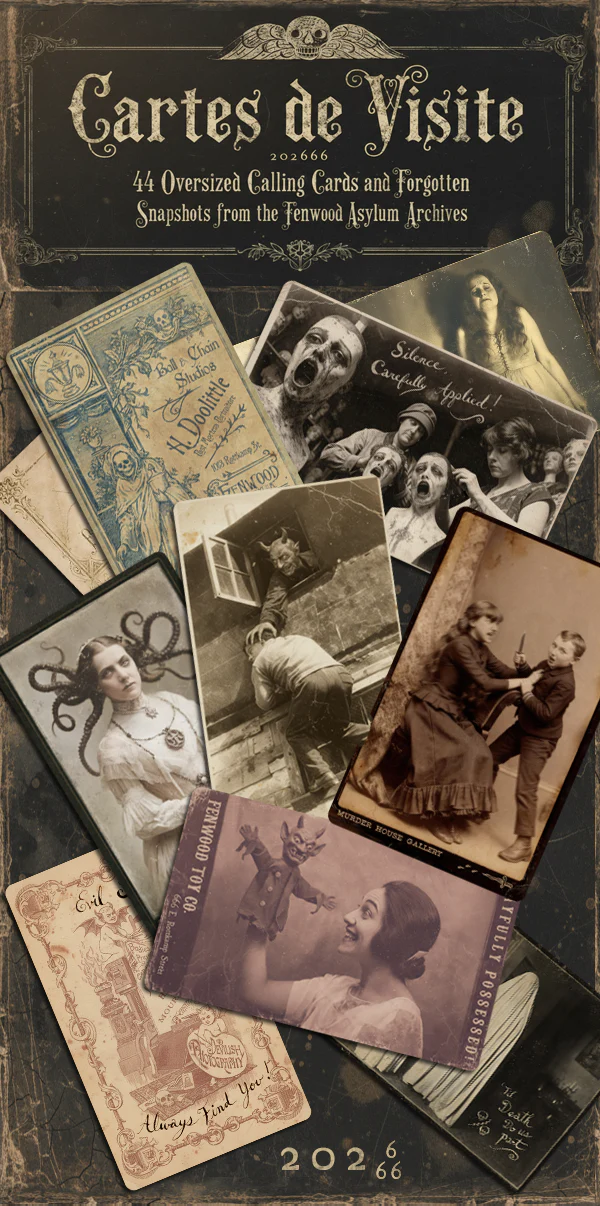
Picture an archive box from a 19th-century psychiatric institution. Inside: portrait cards of patients, each with a case note written on the back. That is what Patrick Valenza has recreated with the Cartes de Visite 202666 Edition.
The cards are based on reworked antique cartes de visite, the small portrait photographs popular in the 19th century. Valenza has applied surrealist image-processing and added handwritten stories describing the residents of the fictional Fenwood Asylum. The 202666 Edition is the expanded successor to a 2015 release that contained 30 cards. This version holds 44, comes in a larger format, and is delivered in a sturdy two-piece lidded box.
What you see on the cards
The fronts show black-and-white portrait photographs in a 19th-century style, altered with surrealist elements. The grain of the original photography is preserved. At the larger format of approximately 89 x 146 mm, the textures read as genuinely old. That size was chosen specifically to make the detail of the alterations visible.
The backs are the core of the deck. Each card carries a handwritten text that tells more about its patient: background, the experiments endured, the relationship to other asylum residents. Together, those texts form a puzzle of Fenwood's history. Reviewers describe it as something close to an escape room in a box.
How you work with it
This deck is not designed for daily readings. It works best when you first treat it as an archive: look at each card, read the reverse, trace the connections between characters. The deck functions as an oracle once you know its residents.
The most common approach is to draw a single card as an addition to a reading with another deck. The question shifts from 'what will happen?' to 'what aspect of this situation am I overlooking?' or 'what internal pattern is active right now?' Valenza describes this territory as shadow work: honest, psychological, not always comfortable.
The format and heavy stock make shuffling in the usual sense difficult. Most people fan the cards across the table or select one from the spread. That approach fits the character of the deck.
Read the backs before you start drawing. The deck needs context to work. Knowing the stories changes what you see in the images.
About Patrick Valenza
Patrick Valenza is the creator of the Deviant Moon Tarot, one of the most recognisable tarot styles of recent decades. His work draws on childhood dreams, old cemeteries and psychiatric institutions. He combines textures from real photographs, such as weathered walls and gravestones, with hand-drawn figures.
Through his company Deviant Moon Inc., based in what he calls 'The Asylum' in New York, he produces limited editions entirely under his own control. The 202666 Edition is the most complete version of the Cartes de Visite project to date.
Specifications
- Number of cards: 44
- Format: approx. 89 x 146 mm
- Language: English (handwritten texts on reverse)
- Packaging: Two-piece lidded box
- Edition: 202666 Edition (successor to the 2015 edition with 30 cards)
- Creator: Patrick Valenza
- Publisher: Deviant Moon Inc.
Questions we often get
What is the difference between this and the 2015 edition?
The 2015 edition contained 30 cards in a simple tuck box. The 202666 Edition has 44 cards, a larger format, more detailed handwritten stories on the reverse, and a sturdy two-piece lidded box. The image processing has also been refined: the scans are sharper and the textures read more clearly at this size.
Does this deck work as a standalone oracle, or does it function better alongside another deck?
Most users draw on this deck as a complement to another deck, such as a tarot or a structured oracle. The cards carry no traditional oracle or tarot structure and no spread instructions. Single-card draws focused on character study or shadow work are the most common approach.