Etteilla: The Book of Thoth Tarot - the oldest system for tarot divination
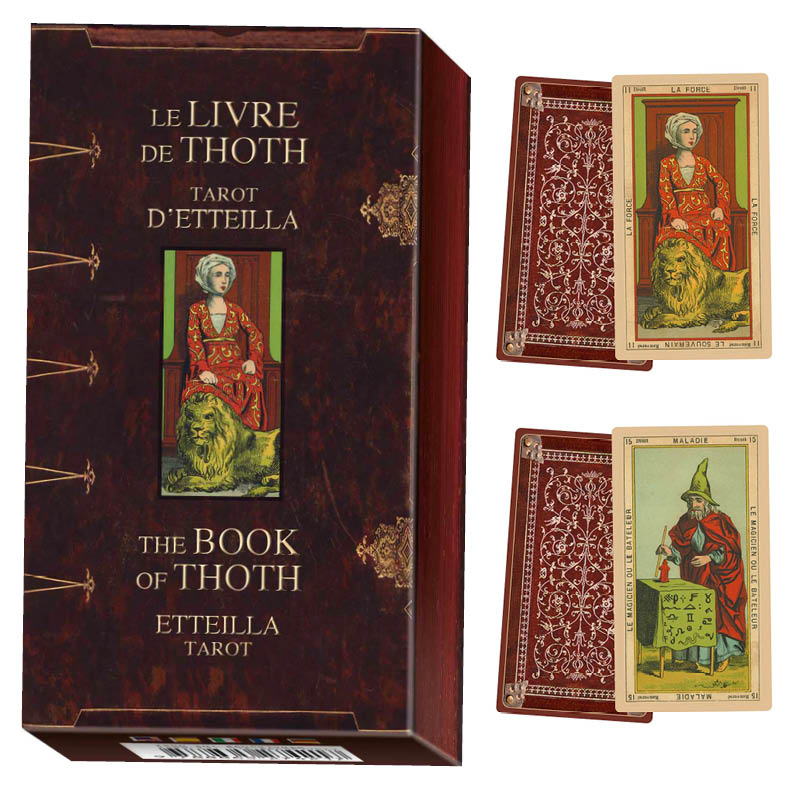
This is not tarot as you probably know it. No Rider-Waite, no illustrated minor arcana, no familiar order. This is the Grande Etteilla III, a reproduction of the Grand Jeu de l'Oracle des Dames from Paris, 1870.
It is the third generation of the system Jean-Baptiste Alliette designed in 1789. He was the first to create a tarot deck meant only for cartomancy, not for playing. And he was the first to earn his living as a professional card reader.
What you see on the cards
Each card carries French titles and keywords along the edges. The style recalls nineteenth-century engravings: grainy, dark, with a certain distance. The major arcana show images that reference Hermetic ideas, astrology and the four elements.
The minor arcana show only suit symbols and keywords. No scenes, no stories. Reading with this deck requires knowledge of Alliette's system. The keywords steer the reading, not the images.
Note: this deck has nothing to do with Aleister Crowley's Thoth Tarot. They share only a name. The traditions are completely different.
How this system works
Alliette broke with the structure of the Tarot de Marseille and built something new. Card 1 is the Querent, not the Fool. The order of the major arcana differs from what you see in modern decks. He wrote down fixed card meanings, introduced reversed positions and designed structured spreads.
Those elements are still the foundation of most tarot practices today. But here you see them in their original form, without the layers other makers have added since.
Start by studying the French keywords before you lay out a full spread. The words are the heart of this system and give you more direction than the images do.
Who this works for
This is not a starter deck. If you are used to Rider-Waite-Smith or similar modern tarot cards, you will need to learn again here. The structure, the meanings, the approach: everything asks for a different view.
This deck is especially valuable for readers who already have some experience and want to see where Western tarot really comes from. Those willing to invest time in Alliette's method gain access to a system that remains influential two hundred years later.
About Jean-Baptiste Alliette
Jean-Baptiste Alliette was born in 1738 and worked as a printer and bookseller in Paris. From around 1770 he devoted himself fully to cartomancy. He published under the name Etteilla, his surname spelled backwards.
In 1770 he wrote the first manual for card reading. In 1789 he designed the first tarot deck intended solely for divination. He believed tarot came from a legendary Egyptian text, the Book of Thoth, and that it contained the wisdom of ancient priests. That conviction shows in the symbolism of his cards.
This reproduction is based on the 1870 edition, made by students from his school. The visual style became more medieval and some major arcana were redrawn. The titles and keywords remained faithful to Alliette's original system.
Specifications
- Number of cards: 78
- Card size: 66 x 120 mm
- Weight: 260 g
- Publisher: Lo Scarabeo
- Card language: French
- Guidebook language: multilingual
- ISBN: 9788865271704
Questions we often get
Can I use this deck if I am just starting with tarot?
That will be difficult. The structure differs at every point from modern decks. The card meanings require study of Alliette's own method. This deck is most valuable if you already have experience and want to learn the historical side of tarot.
What is the difference between the 1789 original and this 1870 edition?
The 1789 original is almost impossible to find and not commercially available. This reproduction is based on the third generation from 1870, made by Alliette's school. The visual style was adapted to a medieval character and some major arcana were redrawn. The titles and keywords remained faithful to the original system.