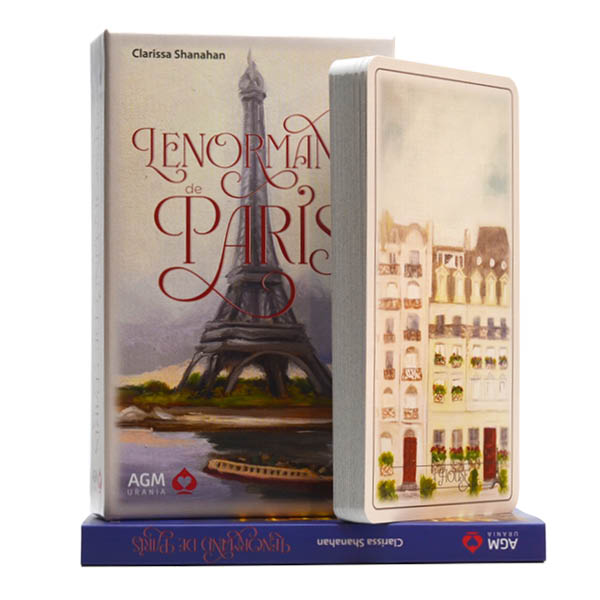
Lenormand de Paris - classic symbolism in Parisian settings
Anyone who thinks Lenormand does not belong in Paris has a point. The origins lie in Germany, not France. But illustrator Clarissa Shanahan deliberately chooses a setting that radiates refinement. The cards show balconies, bridges, terraces and interiors from the 18th and 19th centuries, with figures in period clothing.
This is not a historically accurate reconstruction. It is a visual language that uses atmosphere to make the traditional Lenormand symbols more recognizable. The ring remains ring, the key remains key. What changes is the setting in which you read them.
What you see on the cards
The illustrations are digital, with soft shadows and warm colors. The lines are detailed, sometimes lightly decorative. Each scene is worked out with architecture, fabrics and accessories from the era of salons and gas lanterns.
The backgrounds often contain small visual hints: a flower, a book, a birdcage. These elements reinforce the traditional meaning of the card but do not change it. This remains a working deck, not an art object.
The cards measure 70 x 120 mm, slightly narrower than a standard tarot deck. The cardstock is sturdy enough for regular use. The print is sharp, the colors are not too bright.
What makes this deck different
Lenormand de Paris contains 38 cards instead of the usual 36. Which two cards are added is not always immediately mentioned in the product information, but it gives you a bit more room in larger spreads.
The guidebook runs 140 pages and explains the basic principles of the Lenormand method. That means: card combinations, position in a spread, and directions in a Grand Tableau. There are no pre-chewed answers, just explanation of how you make connections yourself.
Shanahan writes that answers manifest at the moment you are ready for them. That is not a mystical statement, but a practical observation. You see what you can see, no more.
Study the backgrounds during a reading. The Parisian streetscape contains details that can strengthen the story of the card, especially in combination readings.
Who this works for
This deck is designed for beginners. The guidebook takes you step by step into the Lenormand system, without assuming too much prior knowledge. At the same time it remains interesting for those who have been working with Lenormand for longer and are looking for a set with a different aesthetic.
The French setting makes the cards more accessible for those who struggle with abstract or overly rigid imagery. Here you see people, spaces, stories. That helps with memorizing meanings and building narrative connections.
About Clarissa Shanahan
Clarissa Shanahan studied painting at the New York Academy of Art and earned her Bachelor of Fine Arts from the University of Pennsylvania. She has been working with tarot and divination cards for over 25 years, which shows through in the way she translates symbols visually.
Her background as a painter is visible in the attention to light, composition and color. The cards are not quick sketches, but worked-out images in which every element has a place.
Specifications
- Number of cards: 38
- Card size: 70 x 120 mm
- Box size: 80 x 130 mm
- Guidebook: 140 pages
- Language: English
- Publisher: U.S. Games Systems
- ISBN: 9781646712083
- Illustrator: Clarissa Shanahan
- Cardstock: durable, sturdy quality
- Print: high quality
Questions we often get
Why does this deck contain 38 cards instead of 36?
The two extra cards offer more possibilities in larger spreads. Which symbols have been added is usually explained in the guidebook. It remains workable within the classic Lenormand system.
Is the guidebook suitable for someone who has never worked with Lenormand?
Yes. The text explains the basics, including card combinations and spreads. You do not need prior knowledge.