Ramses - Tarot of Eternity - realism instead of romance
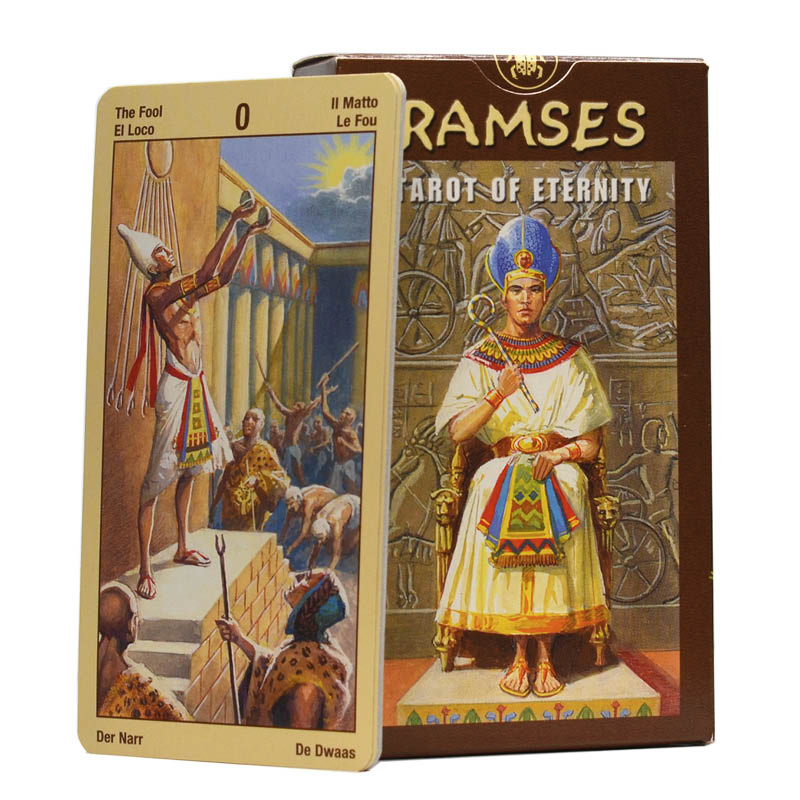
Many Egyptian tarot decks use golden imagery, fantasy gods and esoteric atmospheres. This one does not. Ramses - Tarot of Eternity shows ancient Egypt as archaeologists believe it looked: dusty, powerful, detailed.
The Major Arcana follows the life of Ramses II, the pharaoh who ruled for 66 years and built monuments still standing today. The Minor Arcana shows daily life: workers along the Nile, priests in the temple, merchants at the market. Not symbolic references, but portraits of people you might have met in Luxor or Memphis around 1250 BCE.
What you see on the cards
Severino Baldi draws in a realistic style more often seen in historical film productions than in tarot. Architecture is accurate. Clothing is based on wall paintings and reliefs. Faces are not ideals, but people.
The colour palette is warm: ochre, sand brown, rust orange, occasionally a deep blue or green from minerals. No neon colours, no excessive gold. The lighting is like an Egyptian afternoon: sharp, with hard shadows.
On the cards you see temple facades, obelisks, Nile scenes with papyrus boats. The symbolism remains tarot, but translated to a specific place and time. The Hermit stands in a desert, not on a mountain top. The Empress sits on a throne with hieroglyphs, not in a garden.
How this deck relates to traditional tarot
The structure is classic: 22 Major Arcana, 56 Minor Arcana divided into four suits. But the imagery differs from Rider-Waite-Smith. You cannot simply project your standard meanings and expect them to fit.
That does not make the deck harder, just different. You have to look at what is there instead of what you expect. The guidebook helps, but real access comes from taking time with each card.
Lay the cards next to a book about Egypt. See if you recognise the temples, gods or scenes. It makes the symbolism more concrete.
Who this deck works for
This deck is not designed for quick answers or daily card pulls. It asks for attention. If you find Egyptology fascinating or have had enough of decks that simplify everything, this works.
The deck asks for some experience with tarot. Not because it is complicated, but because you need to improvise when a card does not immediately match what you have learned.
About Severino Baldi and Giordano Berti
Severino Baldi is an illustrator specialising in historical reconstructions. His work appears in educational books and exhibitions. For this deck he studied architectural details, clothing styles and everyday objects from the 19th dynasty.
Giordano Berti is a historian and author specialising in tarot history and iconography. He made sure the cards are not only visually accurate, but also fit within the structure of tarot.
Specifications
- Number of cards: 78
- Size: 66 x 120 mm
- Language: multilingual, guidebook in English
- Publisher: Lo Scarabeo
- ISBN: 9788883952388
- Weight: 234 g
- Finish: high-quality cardstock with matte finish
- Illustrator: Severino Baldi
- Author: Giordano Berti
Questions we often get
Does this deck differ much from Rider-Waite-Smith?
Yes. The structure is the same, but the imagery is completely its own. If you are used to standard symbolism, you need to adjust. The guidebook gives meanings per card, but your own visual interpretation remains important.
Is the guidebook sufficient to work with?
The guidebook is multilingual and contains basic meanings. No extensive spreads or philosophical texts, but enough to start. The cards themselves tell most of the story.