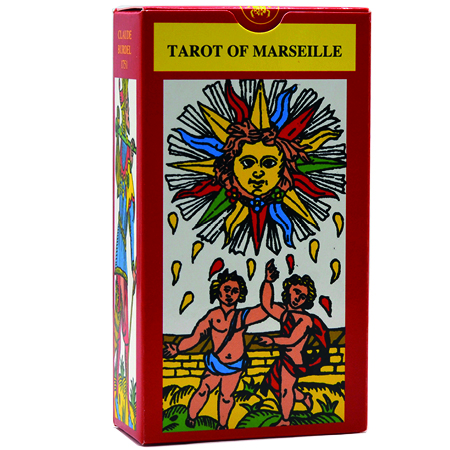
Tarot of Marseille - Claude Burdel's woodcut edition from 1751
The Tarot of Marseille exists in dozens of variants. This edition is based on the cards Claude Burdel made and printed in Switzerland in 1751. His version is known for its clear composition and the hand-coloured quality that many later editions lost.
Lo Scarabeo restored the cards with respect for the original woodcut style. The colours are primary: red, blue, yellow, green. The figures are angular and frontal. There is no psychological depth in the faces, but there is in the symbolism they carry.
What sets this deck apart from other Marseille variants
Most Marseille cards you buy today are based on the Nicolas Conver deck from 1760 or the Grimaud version from 1930. Burdel's cards are older and have a slightly different symbolic language. The Maiden in the Major Arcana wears a different crown, for example. The Moon shows two dogs instead of one dog and one wolf.
These are subtle differences, but they count if you want to follow the historical development of the Marseille tradition. For collectors or anyone laying multiple editions side by side, this is one of the source versions.
What you see and feel
The cards are compact: 66 by 120 millimetres. The cardstock is sturdy, not thick. The finish is matte, which means little reflection under artificial light. The colours are bright without being garish, the lines sharp without feeling modern.
The Minor Arcana are non-scenic. You see wands, swords, cups and coins in symmetrical patterns. There are no characters on these cards, only the objects themselves. That requires a different way of reading than a Rider-Waite system.
When laying out cards, notice where the figures are looking. In the Burdel version the characters often deliberately look at each other or deliberately away. That gives direction to the energy between the cards.
Who this deck works for
This is not a beginner deck. The Minor Arcana contain no pictorial narratives and the guidebook is concise. The deck assumes you know the basics of numerology and colour symbolism, or are willing to learn them through practice.
Those who already work with tarot and want to understand the historical line will find a workable instrument here. The simplicity forces you to read intuitively rather than look up meanings.
About Claude Burdel
Claude Burdel was a cardmaker and engraver from Fribourg, Switzerland. He lived between 1727 and 1799 and made playing cards, tarot cards and other printed imagery. His Marseille cards from 1751 are among the oldest completely preserved sets in this system.
What distinguishes his work is the consistency in the symbolism and the clarity of the woodcuts. Many later publishers copied his work but lost details in the printing process.
Specifications
- Number of cards: 78 (22 Major Arcana, 56 Minor Arcana)
- Size: 66 x 120 mm
- Material: Sturdy cardstock with matte finish
- Language: Multilingual (English, Italian, French, Spanish, German)
- Publisher: Lo Scarabeo
- ISBN: 9788883955945
- Original creator: Claude Burdel, 1751
Questions we often get
How does this deck differ from the Conver version?
The Conver cards date from 1760 and have slightly richer detail. The Burdel version is tighter and older. Both are classic Marseille cards, but with subtle iconographic differences.
Are the Minor Arcana usable without scenic images?
Yes, if you are willing to work with numerology and colour. Many readers actually experience more freedom without pre-digested pictures. It does require practice.