
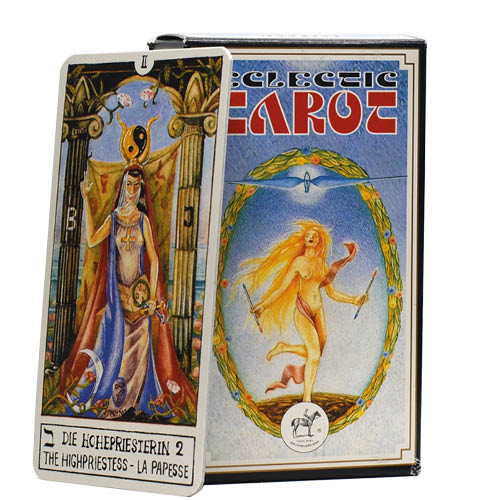
Eclectic Tarot
€ 20,50
€ 85,00
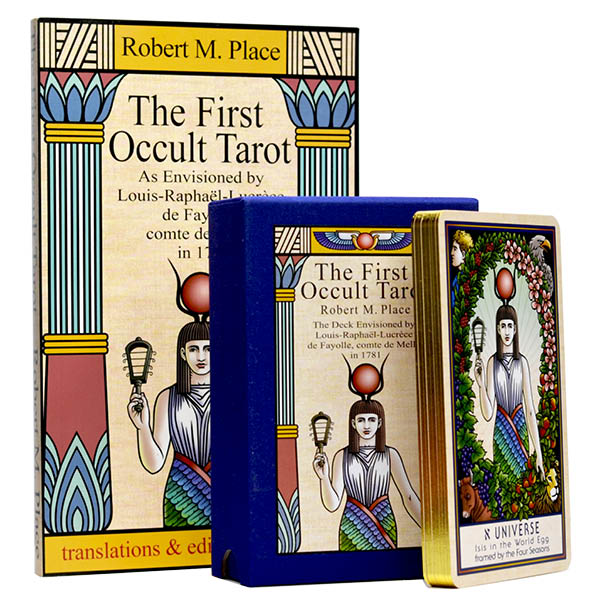
This set brings the earliest recorded occult interpretation of the tarot to life as a complete, playable deck. Based on the 1781 writings of Comte de Mellet, illustrated and researched by Robert M. Place, it includes 78 cards printed on heavy card stock with a matte finish and gold edges, plus a 143-page guidebook.
For anyone who wants to work with the tarot at its oldest recorded occult root.
Only 7 left in stock
Before Waite and Colman Smith, before the Golden Dawn, before Éliphas Lévi and Etteilla, there was Comte de Mellet. In 1781, writing in Antoine Court de Gébelin's encyclopaedia Monde primitif, he set down the first occult interpretation of the tarot ever committed to paper. Until now, that vision existed only as text.
Robert M. Place drew the 78 cards that belong to that vision and wrote a 143-page guidebook to accompany them. Together they form The First Occult Tarot, the first complete set to realise De Mellet's system as a working deck.
De Mellet linked the major arcana to the Classical Ages of Man: the Age of Gold, the Age of Silver, and the Age of Iron. He correlated the trumps with letters of the Hebrew alphabet and provided the earliest known description of a divination technique for the tarot. That framework is the foundation of this deck.
Place developed that system in his characteristic line-drawing style: detailed, symbolically grounded, built on historical research. The cards measure 3.5 by 5 inches, printed on heavy card stock with a matte finish and gold edges.
The 143-page guidebook is not an appendix. Place uses it to describe the historical context of De Mellet's work, the meaning of the Hebrew alphabet correspondences, and how this system differs from later occult traditions. Those who know the tarot through Rider-Waite-Smith will find that the sequence and symbolism diverge in significant ways.
This is not a deck you grasp by looking at the cards alone. The guidebook is inseparable from the set.
Read the historical introduction before laying the cards for the first time. De Mellet's system has its own logic, and the readings make more sense once you understand the framework behind them.
Robert M. Place is an artist, researcher, and the illustrator behind the Alchemical Tarot, the Tarot of the Saints, the Vampire Tarot, and the Raziel Tarot, among others. His book The Tarot: History, Symbolism, and Divination was described by Booklist as possibly the best book ever written on tarot.
Place lectures and teaches on tarot and mysticism, and has curated tarot art exhibitions including one that originated at the LA Craft and Folk-Art Museum. The First Occult Tarot grows directly from his years of historical research into the origins of occult tarot.
How does this deck differ from the Rider-Waite-Smith tarot?
This deck is built on a system described forty years before Waite and Colman Smith's work. The sequence of the major arcana, the symbolism, and the correlation with the Hebrew alphabet are different. This is not an alternative illustration style laid over familiar structures. It is a fundamentally distinct occult approach to the tarot.
Is the guidebook available separately?
No. The guidebook is part of this set and is not sold separately. It was written specifically to explain this deck and De Mellet's historical vision.
| Author | Robert M. Place |
| Language | English |
| Publisher | Self-Published Decks |
| ISBN | 9781736068847 |
| SKU | 1772-RP03 |
Since 1999, Tarot.nl has been the trusted source for the largest collection of cards in the Benelux. As a Dutch family business, we personally select every deck based on quality and character.
Dive into the world of Tarot.nl by subscribing to our engaging newsletter.
This site uses tracking technologies. You may opt in or opt out of the use of these technologies.