The Quên Tarot - Best Tarot Deck 2022 winner with Vietnamese visual language
Not every award-winning deck truly deserves the title. This one does. The Quên Tarot by Vietnamese artist Duy Khanh Vo won the 2022 CARTA Award for Best Tarot Deck of the Year, and that is no accident.
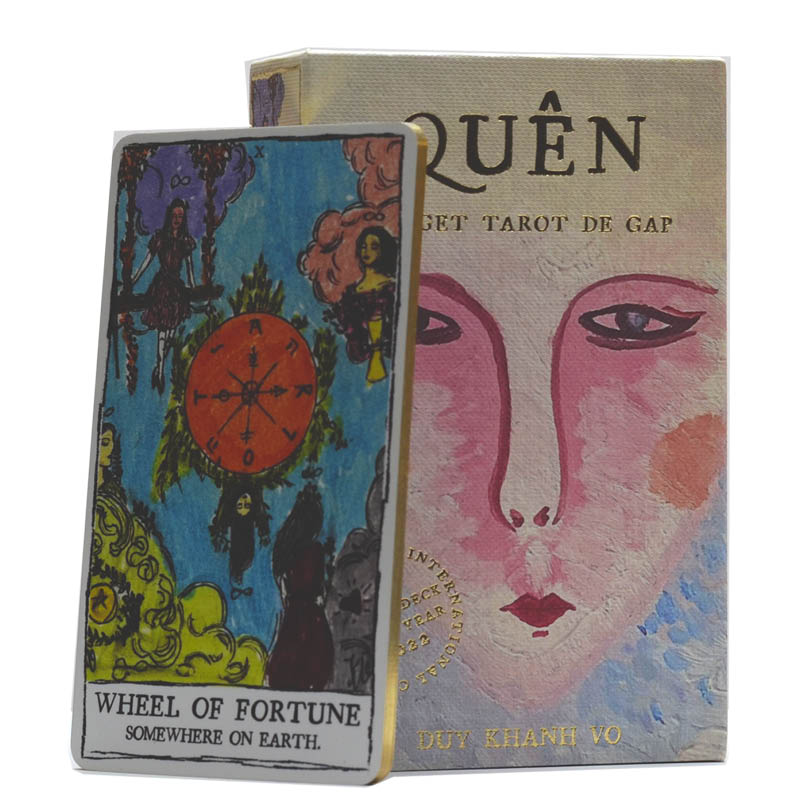
Vo painted all 85 cards by hand. The images mix Vietnamese cityscapes with personal memories, emotional themes and the classic tarot structure. The result is a deck where you find both recognition and unfamiliarity, depending on what you bring to it.
What you see on the cards
The colours are soft but not sweet. Many pastel tones, occasional hard contrasts. The compositions are dense: many details, many layers, much to look at. Cityscapes recur, as do architectural elements typical of Vietnam.
The 78 classic tarot cards are supplemented with seven extra cards: the Fool's Journey series and an Artist card. These extra cards give Vo space to tell his own story within the structure of the system. They are not necessary to use the deck, but they deepen what is already there.
Each card has copper or gold edges. This is not decoration but a choice that makes the cards feel physically heavier in the hand. The paper is 310 gsm Titan with water-resistant lamination. It feels sturdy, not slick.
How this deck relates to classic tarot
The structure is Rider-Waite-Smith. All familiar arcana and positions are present. But the visual language is entirely its own. No medieval European symbolism, no repetitions of known scenes.
This means you can read this deck with classic knowledge, but you will need to reinterpret the cards themselves. The Tower does not show a collapsing castle. The Sun does not show a blond child on a horse. What you do see asks for a different way of looking.
Draw one card per day and write down what you see before looking at the meaning. The images are strong enough to speak for themselves.
Who this works for
This is not a beginner deck. The symbolism deviates too far from what you find in a classic RWS deck. If you learn tarot with this deck, you learn this deck, not the system.
Those already working with tarot and looking for a different visual language will find a deck here that feels both familiar and foreign. The extra cards offer space for experimental spreads. The quality makes daily use pleasant.
Collectors know: this is the second and final print run. No reprint planned. The certificate of authenticity is included in the box.
No physical guidebook
There is no booklet in the box. Instead you find a QR code that leads you to a digital guidebook. That guidebook contains card meanings, background information about the creator and explanations of the extra cards.
Whether you find this convenient depends on how you work. Reaching for your phone during a reading interrupts the rhythm for some people. For others it is practical: the text can always be updated, always available.
About Duy Khanh Vo
Duy Khanh Vo is from Vietnam and created this deck at age 24. The Quên Tarot is his sixth project and is described by him as his most mature work to date.
His style is characterized by hand-painted images with strong emotional charge. Love, loss and identity recur as themes. His work is personal without becoming sentimental.
Specifications
- Number of cards: 85 (78 classic tarot cards + 7 extra cards)
- Card size: 70 × 120 mm
- Paper: 310 gsm Titan paper with OPP lamination (water-resistant)
- Finish: Copper or gold card edges
- Packaging: Luxury canvas magnetic box with foil printing
- Extras: Certificate of authenticity, digital guidebook via QR code
- Language: English (digital guidebook)
- Illustrator: Duy Khanh Vo
- Edition: Second and final print run, no reprint planned
Questions we often get
What is the difference between the copper and gold edition?
Only the colour of the card edges and the sticker on the outside of the box. In content both versions are identical.
Can I use this deck if I am used to Rider-Waite-Smith?
Yes, the structure is the same. But the visual language differs significantly, so you will need to relearn the cards. Do not expect direct visual recognition.