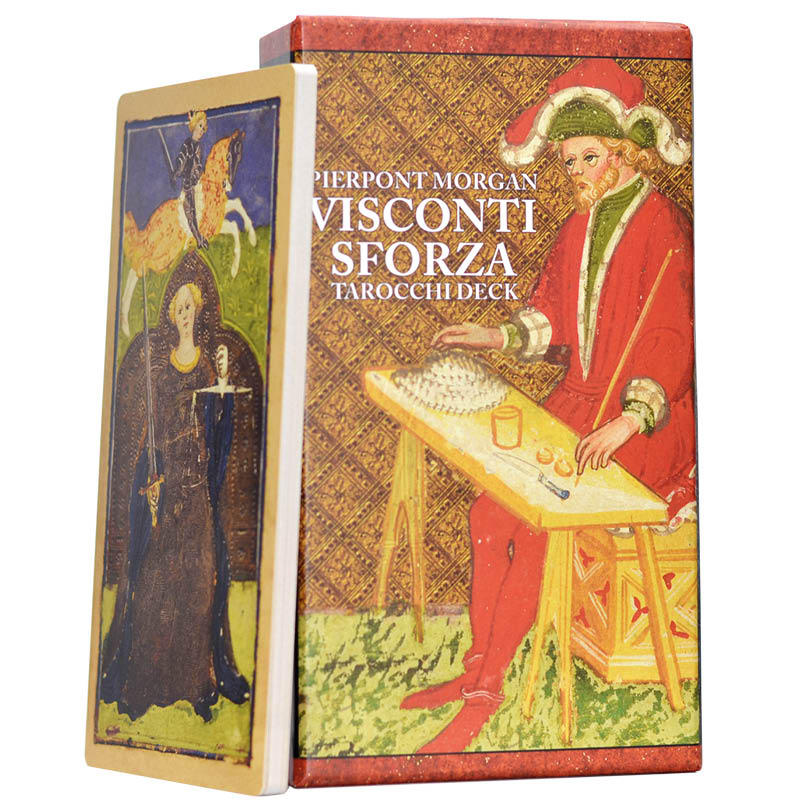
Visconti-Sforza Tarocchi - reproduction of 15th-century Milanese tarot deck
This is one of the oldest tarot decks of which cards have survived. The original was painted around 1450 for the Visconti and Sforza families, two powerful noble houses in Milan. The cards were made as a status symbol and are decorated with gold leaf.
This reproduction is based on cards now scattered across various museums and private collections. Four missing cards have been reconstructed in the same style to complete the deck.
What you see on the cards
The figures wear clothing from the late Middle Ages. Cloaks, tunics, weapons, crowns: everything is drawn in detail. The decorations imitate the original gold leaf with gold accents on clothing, backgrounds and emblems.
The cards are large: 173 x 87 mm. This means you can see the details clearly. Lines, facial expressions, fabrics, patterns: everything comes through. The style is 15th-century: flat perspectives, formal postures, medieval symbolism.
There are no modern esoteric symbols on the cards. No astrological signs, no Hebrew letters, no magical attributes added later. Only the imagery of the Renaissance.
Who this deck is made for
This deck is first and foremost a historical document. It shows what tarot looked like before the Rider-Waite system, before the influence of 19th-century occultists, before modern interpretations.
Collectors seek this deck for the history. Readers accustomed to classic systems can use it for spreads, but must rely on visual perception. The cards give no textual hints.
Take one card and look at the clothing, the posture, the attributes for a few minutes. The meaning lies in what the figure wears and does, not in what is written.
About Stuart R. Kaplan
The guidebook for this deck was written by Stuart R. Kaplan, founder of U.S. Games Systems and author of the four-volume Encyclopedia of Tarot. Kaplan has spent decades researching the history of tarot and has had access to archives and museums around the world.
In the 60-page guidebook he describes the historical context of the Visconti-Sforza cards and gives interpretations that highlight both the original meaning and modern application.
Specifications
- Number of cards: 78 (including 4 reconstructed cards)
- Card size: 173 x 87 mm
- Language: English
- Guidebook: 60 pages with color illustrations
- Guidebook author: Stuart R. Kaplan
- Publisher: U.S. Games Systems Inc.
- Packaging: hinged box
- Cardstock: sturdy, matte finish
Questions we often get
Are these exact replicas of the original cards?
The images are reproduced as faithfully as possible from the surviving cards. Four cards were missing from the original set and have been reconstructed by artists in the style of the other cards, so the deck is complete for use.
Can I use this deck if I am used to Rider-Waite?
Yes, the structure is the same: 22 major arcana and 56 minor arcana. The imagery is different and there are no modern keywords or symbols. You must rely more on what you see than on fixed meanings.