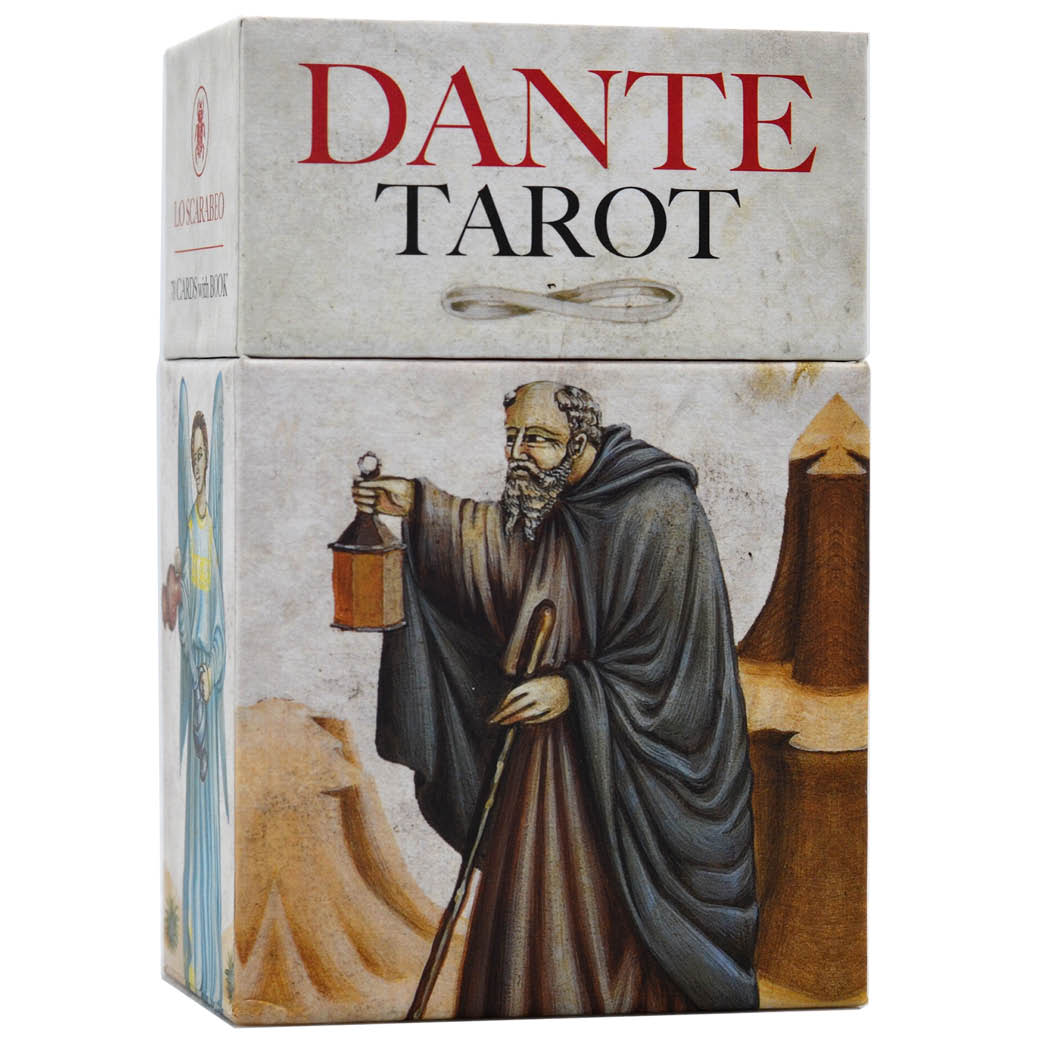
Tarot el Dante - literary tarot based on the Divine Comedy
Literary tarot decks are rare, and rarer still are those that manage to translate a classic story visually without it feeling forced. This deck works because Guido Zibordi Marchesi does not impose the structure of Dante's 'Divine Comedy' onto the tarot, but lets both systems exist alongside each other.
The journey through hell, purgatory and paradise forms the underlying logic of the major arcana. The minor arcana follow the Rider-Waite-Smith structure, but translated into the late medieval visual language that belongs to Dante's era. The result is a deck that remains both recognizable and distinct.
What you see on the cards
The cards are borderless, which means the images run to the edge. This strengthens the clarity of the compositions. The colours are saturated and bright, not muted as you might sometimes expect with medieval aesthetics. Red, gold, blue and green dominate, sharp enough to keep details readable from a distance.
The style recalls 14th-century frescoes and manuscript illuminations, with flat planes and little perspective. Figures are frontal or in profile, faces are stylized. This makes the images calmer than many contemporary tarot decks, but also more direct. There is no loose atmosphere, only what is needed for the scene.
How this deck relates to other tarot
The structure follows Rider-Waite-Smith, so if you are familiar with that symbolism you can start right away. But the visual language does ask you to look at the cards anew. A scene that in a classic RWS deck is contemporary or neutral gets a medieval context here. That shifts the associations.
This is not a deck for quick answers. The layering of the images takes time. Many people use it for questions about direction, transformation or moral choices, questions that fit the philosophical core of Dante's work.
Pull one card and let it sit for a day before you settle on a meaning. The images are rich enough to land differently more than once.
About Guido Zibordi Marchesi
Guido Zibordi Marchesi is an Italian artist who specializes in historical art styles translated into tarot. His strength lies in understanding both the original visual language and the requirements of a workable tarot deck. He does not just paint beautifully, he knows which details you need to be able to read a card.
Specifications
- Number of cards: 78
- Size: 66 x 120 mm
- Design: borderless
- Language: multilingual (English, Italian, Spanish, French, German)
- Publisher: Lo Scarabeo
- Artist: Guido Zibordi Marchesi
- Weight: 260 g
Questions we often get
Do I need to have read the Divine Comedy to use this deck?
No. Knowledge of the story enriches the experience, but the cards work without it. The images stand on their own and follow the tarot structure you probably already know.
How does this deck differ from other historical tarot decks like the Visconti or Marseille?
This deck is based on Rider-Waite-Smith, not on the older Italian traditions. The medieval style is visual, not structural. That makes it more accessible than a Marseille deck, but with a different visual language than standard RWS.