Green Codex Tarot Set - ecology and tarot brought together in one kit
Not every tarot deck integrates nature into its symbolism. This one does, and in a way that goes beyond a leaf motif on the card backs. The Green Codex Tarot Set is designed as a bridge between human psychology and ecological awareness.
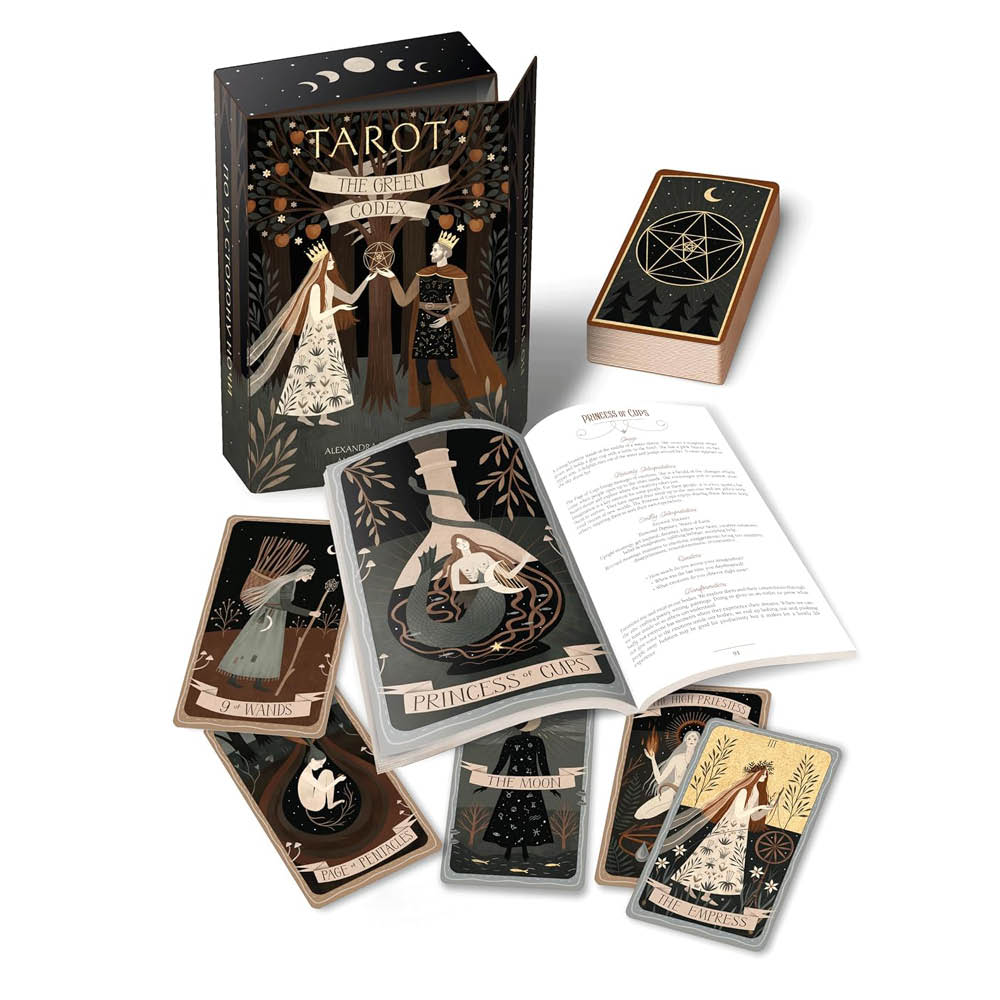
It is a collaboration between illustrator Alexandra Dvornikova and psychiatrist Alexander Kopytin, chair of the Russian Art Therapy Association. The cards breathe a nocturnal calm: dark backgrounds, earthy colours, symbols that reference forest and silence. This is not a light deck.
What you see on the cards
The imagery is minimalist, with attention to texture and atmosphere. Dvornikova works with folkloric elements: pines, stars, shadows. The colours are muted, mostly green, brown and night blue.
The cards follow the standard tarot structure: 22 major arcana and 56 minor arcana. The symbolism stays close to classical meanings but translates them into natural processes and ecosystems. That asks for a different way of looking.
The guidebook: ecopsychology in practice
The 192-page guidebook is not a lightweight companion booklet. It is a full book in which Kopytin combines ecopsychology and art therapy with tarot interpretations. Each card receives explanation from both a psychological and an ecological perspective.
That means no quick keywords, but descriptions that ask for time. The text is written for those interested in the relationship between inner processes and natural environment. The focus lies on reflection, not prediction.
Draw a card and take it with you on a walk. Notice whether you see the symbolism reflected in what you encounter: a tree, a stone, the wind. The deck is built for that kind of work.
Who this works for
This deck is not designed as an entry-level deck. The cards offer little support if you are not yet familiar with tarot. The guidebook compensates for this in part, but does ask for patience.
The deck is aimed at people with an interest in ecopsychology, art therapy or a more contemplative approach to tarot. The tone is thoughtful, sometimes philosophical. Those looking for clear answers or quick readings will find less use here.
About Alexandra Dvornikova and Alexander Kopytin
Alexandra Dvornikova studied at the Stieglitz State Academy in Saint Petersburg and works with folklore and natural materials. Her style is recognisably earthy, with strong attention to texture and atmosphere.
Alexander Kopytin is a psychiatrist and chair of the Russian Art Therapy Association. In this project he combines his knowledge of art therapy with a focus on ecological awareness. The guidebook carries his signature: thorough, psychologically grounded, focused on growth.
Specifications
- Number of cards: 78
- Guidebook: 192 pages
- Language: English
- Publisher: Llewellyn Publications
- ISBN: 9780738782249
- Kit dimensions: 135 x 210 x 53 mm
- Weight: 950 g
- Finish: matte
- Illustrator: Alexandra Dvornikova
- Author of guidebook: Alexander Kopytin
Questions we often get
Is this deck suitable for beginners?
No. The cards contain no keywords and the imagery is subtle. The guidebook does offer in-depth explanation, but requires an interest in ecopsychology and art therapy. Those just starting with tarot will benefit from a more accessible deck.
How does this deck differ from other nature-themed decks?
The Green Codex Tarot explicitly connects tarot with ecopsychology. It is not just about nature imagery, but about the relationship between psyche and ecosystem. The guidebook treats this extensively and from a therapeutic perspective.