Book of the Dead Oracle - 48 oil painting cards on the afterlife
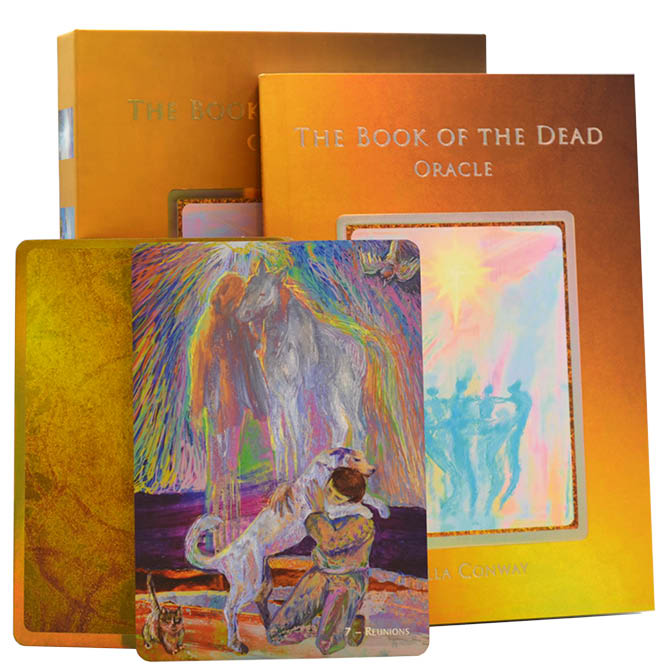
Most oracle cards begin with life. This one begins with death, and moves from there. Cilla Conway painted the 48 cards of the Book of the Dead Oracle during the first lockdown of 2020, starting from loose oil paintings already lying in her studio: a ghost horse, a demon, figures that looked like lost spirits. It was a personal response to a period of collective uncertainty, shaped by extensive research into near-death experiences.
The result is an oracle that does not shy away from death but looks closely at what may come after. That is an uncommon starting point, and the cards carry that seriousness throughout.
Four paths, forty-eight paintings
Conway divides the afterlife into four paths. Souls on the first path arrive clear and aware. The second offers curiosity and gardens to walk through. The third is the path of lost souls: confused, unsure they have died, still hovering near their old lives. The fourth is the darkest: souls Conway describes as cold and obdurate, who go down rather than up.
That structure gives the cards a wide emotional range. Some images are light and expansive. Others are genuinely unsettling. The comparison to William Blake is deliberate: Conway works in abstraction but with the same layering of colour, movement, and self-built mythology.
The cards are printed borderless. The edges carry a holographic finish, as does the pattern on the back. That gives the cards a physical presence that is satisfying without being showy.
What the guidebook covers
The guidebook gives two pages to each card: one describing the event or state depicted in the image, the other offering interpretation approaches for a reading, with space for personal notes. That is a practical format that leaves room for individual association.
Conway also includes descriptions of actual readings she has done for friends and clients, which makes it easier to understand how the cards work together in practice. The book closes with a grounding meditation and references for further reading on near-death experiences and the afterlife.
Conway is explicit about one thing: this oracle carries a benevolent energy, but it should be used with respect. She describes how the cards can be used to send or receive messages from souls who have crossed over, for ancestor work, clearing energies, or exploring past lives. Those are specific applications that give this deck a different weight than most daily-use oracles.
Conway's own words on working without respect: what you might attract is 'best left well alone'. She is not being dramatic. She means it as a practical caution.
About Cilla Conway
Cilla Conway is an internationally known fine artist who has created six previous tarot and oracle decks, including The Byzantine Tarot, The Shimmering Veil Tarot, and the Multi-Dimensional Deva deck. This project began spontaneously: after completing that last deck, she looked at the paintings still on her floor and recognised the beginnings of a western Book of the Dead.
She publishes under her own imprint, cc3 Publications. Reviewer John Matthews, a writer and mythologist, notes that no commercial publisher is currently producing anything comparable in terms of craftsmanship and production quality.
Specifications
- Number of cards: 48
- Language: English
- ISBN: 9781527294011
- Publisher: cc3 Publications
- Creator: Cilla Conway
- Technique: Oil paintings
- Finish: Borderless cards with holographic edges and holographic detail on the back
- Guidebook: Two pages per card, readings from practice, grounding meditation, references
Questions we often get
Can I use this for everyday card pulls?
You can, but the cards are consistently oriented around death, the afterlife, ancestors, and past lives. Conway describes readings of two to six cards in one or two rows, so the format is straightforward. Whether the subject matter fits your daily practice depends on what you are looking for.
What language are the cards and guidebook in?
Everything is in English. Card titles appear on the cards themselves, and the guidebook is fully in English.