The Haptic Tarot - Renaissance Art and the Sense of Touch as Tarot Language
About this deck
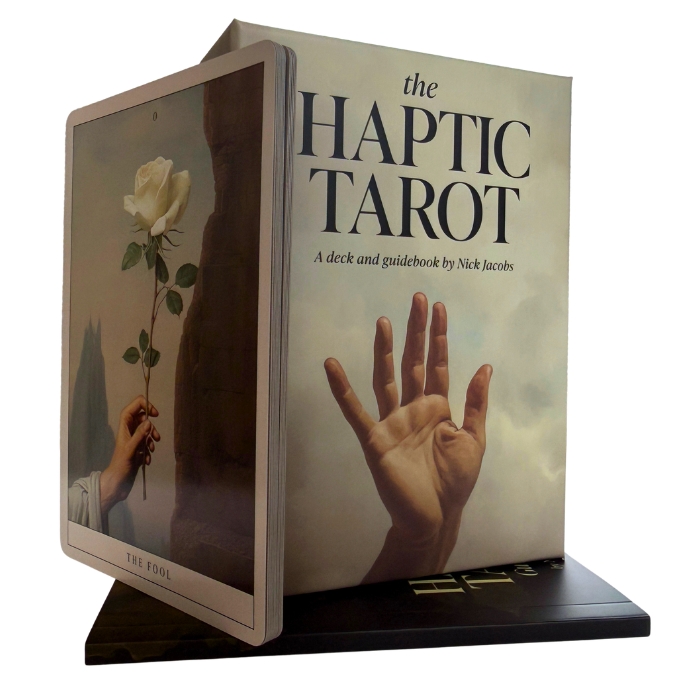
The Haptic Tarot is a 79-card deck in which hands serve as the central storytelling element across every image. The visual reference point is Jan van Eyck, the early Flemish Renaissance painter whose work is celebrated for its extraordinary precision, depth of light, and almost tactile rendering of surface and texture. Nick Jacobs, a tarot reader and designer with over 20 years of experience, created the artwork through a thoughtfully guided generative AI process, shaping each image through his own prompts and curation. The result sits firmly within the Smith-Waite tradition while looking and feeling unlike any deck currently in circulation. A bonus card, The Reader, sits outside the standard 78-card structure and adds an additional reflective layer to the set. The deck is packaged in a sturdy two-piece box with luxurious card stock designed to shuffle smoothly.
Symbolism and themes
'Haptic' refers to our sense of touch, and that concept shapes the imagery throughout the deck from the major arcana to the pips. In every card, hands are the expressive centre: they gesture, grasp, release, point, and reach in ways that carry meaning before a single word of the guidebook is read. This gives the deck a directness and immediacy that rewards slow, attentive looking. The visual style draws on Van Eyck's realist palette, with rich fabric textures, dramatic use of light, and a depth of detail that gives each card the feeling of a small painting. Classical tarot iconography remains intact and recognisable throughout, so the deck speaks clearly to anyone familiar with Rider-Waite symbolism while offering a completely different visual experience.
The creator
Nick Jacobs is a tarot reader, mentor, writer, and designer based in San Francisco, California, where he lives with his husband and their dog Matilda. He has been studying and working with tarot for over 20 years, bringing together a background in design and art history to create The Haptic Tarot. He runs his own tarot reading business, Page of Cups Tarot Readings, and sees the cards as a tool for meaningful, actionable reflection rather than as a fortune-telling device. The Haptic Tarot is the direct expression of his belief that tarot is one of the most complete representations of human experience available.
Practical use
The 60-page guidebook provides three keywords for every one of the 79 cards, making it easy to get oriented quickly without needing to read long passages mid-reading. Three tarot spreads are included for readers who want a structured framework. Because the imagery is rooted in hand gestures and physical posture, this deck works particularly well for body-based or somatic approaches to reading, where you notice what you physically feel in response to an image before reaching for an intellectual interpretation. Readers familiar with Rider-Waite will find the structure immediately navigable, but the visual language asks for a slightly slower pace: the hands in each card tell their own story and are worth reading independently of the scene around them.
Try covering the background of a card and reading only the hands: what does the gesture say to you right now, before anything else? Let that be your starting point for the reading.
Features of the The Haptic Tarot
- Author: Nick Jacobs
- ISBN: 9781646713066
- Number of cards: 79 (including bonus card The Reader)
- Guidebook: 60 pages
- Language: English
- Card dimensions: 68.8 x 119.9 mm
- Box dimensions: 72.9 x 123.9 mm
- Packaging: Sturdy two-piece box
- Card stock: Luxurious, smooth-shuffling
- Available: July 2026
Expert FAQ about The Haptic Tarot
What does 'haptic' mean in the context of this tarot deck?
'Haptic' refers to the sense of touch and our ability to receive and process information through physical sensation. In this deck, that principle translates into imagery where hands are the primary storytelling element in every card. Rather than relying on full-scene symbolism alone, Nick Jacobs built the visual language around gesture and physical posture, so that the meaning of each card can be approached through what the hands are doing. It is a deliberate design choice that ties the act of reading tarot back to something bodily and intuitive.
Was this deck made entirely by AI, or was a human artist involved?
The artwork was created through a generative AI process that was guided, shaped, and curated by Nick Jacobs himself. He directed the visual output through his own prompts, made selections, and applied his background in design and art history throughout the process. The AI was a creative tool in his hands, not an autonomous generator. The result reflects his 20-plus years of tarot knowledge and his specific aesthetic vision rooted in Jan van Eyck's early Flemish Renaissance painting.