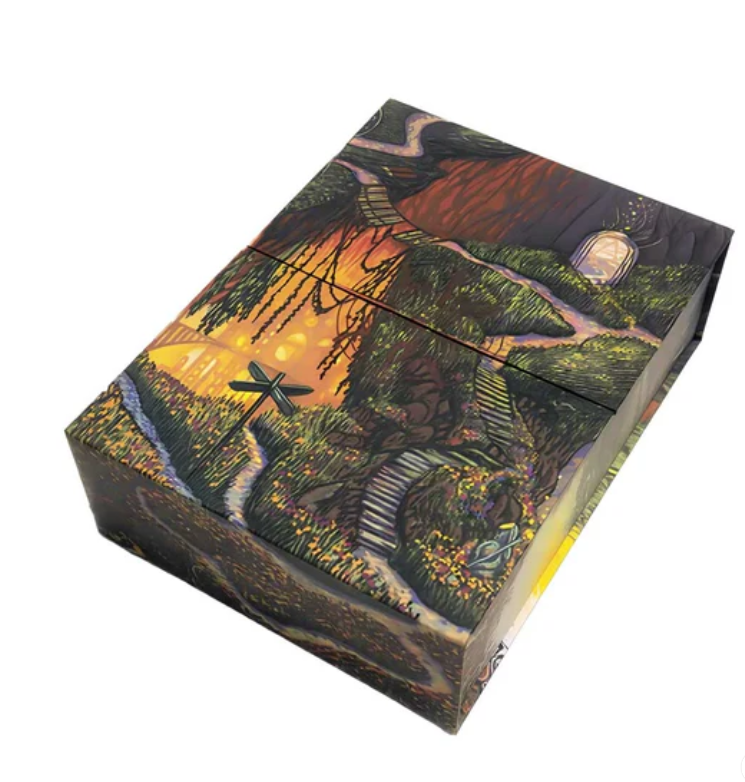
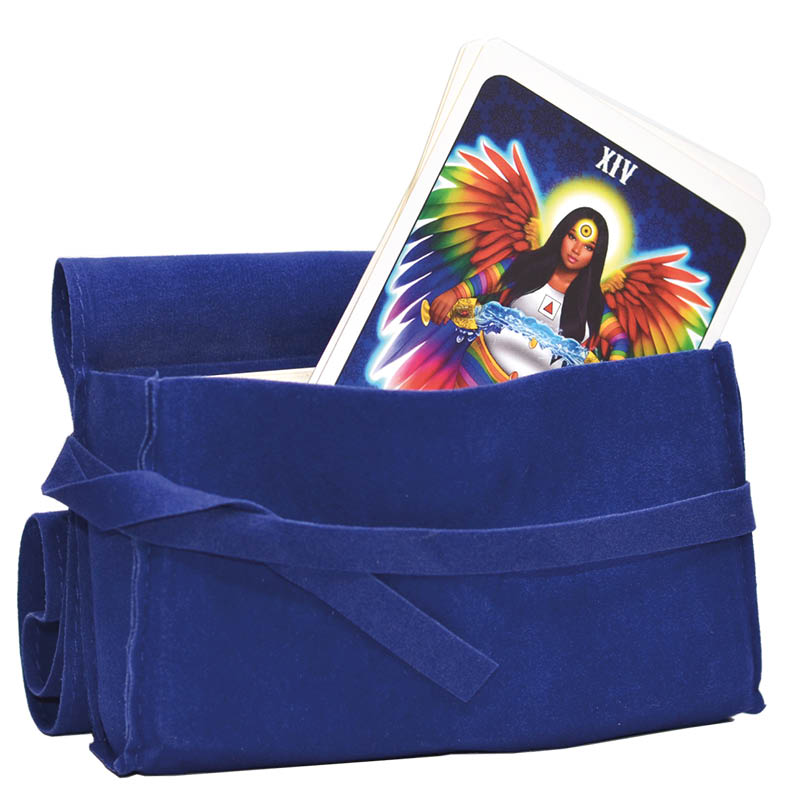
The Oracle of Many Paths - 78 cards forming one panoramic landscape
Most oracle cards stand alone. The Oracle of Many Paths works differently by design: all 78 cards are fragments of the same world. Lay them side by side and they form one sprawling map of a forgotten land, seen from above, with paths that branch, reconnect, and sometimes end without explanation.
The idea is not just visual. It runs through the whole system. Every card contains at least one path. Some branch. Some reconnect. Others stop without warning. That is not an accident. James R. Eads built it as a visual metaphor for how change actually moves.
What you see on the cards
The cards are standard tarot size and numbered from 00 to 77, making them easy to locate in the guidebook. The edges are gilded in a dark green metallic finish, with rose gold foil accents on the card faces. The back of every card shows a marbled pattern made using the traditional Ebru technique, in which pigment floats on water before being transferred to paper.
Eads studied screenprinting, painting and graphic design in New York before returning to Los Angeles to make posters for artists including Phish, the Foo Fighters and Dave Matthews Band, and for festivals such as Bonnaroo. The Oracle of Many Paths was in development for more than three years.
The guidebook: lore and interpretation
The guidebook runs to 108 full-colour pages and has a hard cover with a cloth binding, a marbled pattern, and a foil compass print on the front. Inside you find a 25-page introduction, five original spreads, notes on numerology and tarot connections, and an explanation of how to read the symbolic paths.
Each card gets its own page with keywords, numerology, backstory and interpretation notes. The text is written from the perspective of a traveller moving through the land long after great events have passed, piecing together fragments of history. That makes the guidebook readable as a standalone story.
How this deck relates to tarot
The Oracle of Many Paths draws on tarot structure, with 78 cards and attention to numerology and archetypes. It is not a tarot deck. The cards follow no fixed major or minor arcana division, and the archetypes here are places in a landscape rather than figures or abstract forces. Those familiar with tarot will recognise certain connections. Those who are not will find everything they need in the guidebook.
The five spreads in the guidebook were designed specifically for this deck and take into account where each card sits within the full landscape. It is worth trying a spread with the cards laid out side by side so you can follow the paths as they run across the borders.
About James R. Eads
James R. Eads was born in 1989 in Los Angeles. After studying in New York he returned to LA and began making posters for bands and festivals. In 2013 he made his first tarot deck, which led to the founding of Prisma Visions.
He has since made close to a dozen tarot and oracle decks. His studio sits in the centre of Los Angeles and is also the home of Prisma Visions. The Oracle of Many Paths reflects his interest in non-linear storytelling and the endlessly branching possibilities that choices open up.
Specifications
- Number of cards: 78
- Card numbering: 00 to 77
- Card size: 70 x 121 mm
- Card finish: Gilded edges (dark green metallic), rose gold foil accents, marbled backs (Ebru technique)
- Guidebook: 108 pages, full colour, hardcover
- Guidebook finish: Cloth binding with marbled pattern, foil compass print
- Guidebook contents: 25-page introduction, 5 spreads, numerology, tarot connections, path interpretation, one page per card
- Box: Sturdy presentation box with magnetic closure and foil compass accent
- Language: English
- Edition: First edition (first print run)
- Publisher: Prisma Visions / TarotArts
- Creator: James R. Eads
Questions we often get
Is this a tarot deck or an oracle deck?
This is an oracle deck of 78 cards, inspired by tarot structure. The cards follow no fixed major or minor arcana division and work with places in a landscape rather than the usual tarot figures. The guidebook includes notes on numerology and tarot connections for those who want to draw that comparison.
Do you need to lay out all 78 cards to see the full landscape?
No. Every card works on its own in a reading. The panoramic landscape is an additional layer: when you place the cards together you can see the paths running across the borders between them. That is a separate use, not a requirement for ordinary readings.
Is this the Kickstarter edition?
No. The deck we supply is the first edition, first print run of The Oracle of Many Paths. The exclusive Kickstarter edition included an additional special card that is not part of this version.