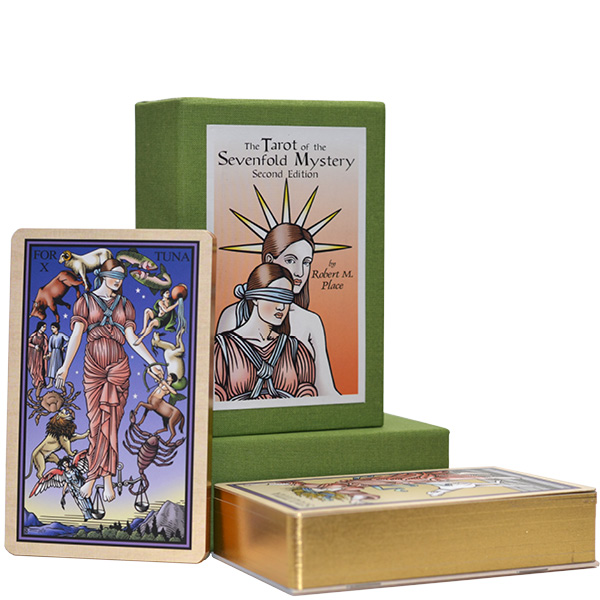
The Tarot of the Sevenfold Mystery - Neoplatonic philosophy in Pre-Raphaelite imagery
Robert M. Place did not design this deck to be beautiful. He designed it to prove a point: that the Tarot, from its very origin, carries Neoplatonic mysticism in its structure, and that this philosophy is still visible if you know where to look. This is a deck with an argument.
Place is the designer and illustrator behind a series of well-known decks, including the original Alchemical Tarot. For this one, he drew on the nineteenth-century painter Edward Burne-Jones, who in turn looked back to Botticelli and Michelangelo. The result is a visual bridge between the fifteenth and the nineteenth century, two periods that both root in the same philosophical tradition.
What the imagery says
The figures on the cards are tall, slender and melancholy in expression, in the characteristic manner of Burne-Jones. The female figures recall Botticelli, the male figures carry something of Michelangelo. The colours are deep and saturated, the linework elegant and at times almost dreamlike.
The second edition adds gold-edged cards. They come in a cloth-covered box with a slipcase. That is not a flourish: it fits the nature of a deck that is designed as much as an art object as a reading tool.
What the 'sevenfold mystery' actually means
Place explains in his notes that the 21 trumps divide into three groups of seven, each corresponding to one of the three Platonic soul levels. The seven planets of ancient cosmology serve as soul centres, ascending from the sacrum to the crown of the head. The three Cardinal Virtues, Temperance, Strength and Justice, drive the ascent through these levels, until the fourth virtue, Prudence, gathers them together in the World card.
The back of the cards shows the Staff of Serapis: a three-headed figure with the heads of a wolf, a lion and a dog. They stand for past, present and future, and at the same time for the three Platonic aspects of the soul. Place chose this Renaissance symbol deliberately as a summary of the system the deck is built on.
How this deck reads
Place describes the deck as readable on many levels, from the everyday to the spiritual. The minor arcana and court cards align in meaning with the Alchemical Tarot. Anyone who knows that deck will recognise the structure.
The philosophical layer makes this a demanding deck. Getting the most from the symbolism benefits from some familiarity with Neoplatonism, Platonic soul theory, or Renaissance art. That is not a requirement for drawing cards, but the difference between surface reading and layered reading lies in that knowledge.
Read Place's commentary on the trumps before working with the deck. Without that context, you see beautiful cards. With it, you see a system.
About Robert M. Place
Robert M. Place is a visual artist, illustrator and writer. He is internationally known as the designer of the original Alchemical Tarot, for which he was also co-author. That was followed by The Tarot of the Saints, The Angels Tarot, The Raziel Tarot, The Vampire Tarot, The Buddha Tarot, and others.
Place also wrote 'The Tarot: History, Symbolism, and Divination', which Booklist described as possibly the best book ever written on the tarot. He has lectured and led workshops on mysticism and tarot across the United States and on five continents.
Specifications
- Number of cards: 78
- Language: English
- Edition: second edition
- Finish: gold-edged cards
- Packaging: cloth-covered box with slipcase
- Author and illustrator: Robert M. Place
Questions we often get
What is different about the second edition?
The second edition has gold-edged cards and comes in a cloth-covered box with a slipcase. The content of the deck and its philosophical framework remain the same.
Do I need to know the Alchemical Tarot to use this deck?
No, that is not a requirement. Place notes that the minor arcana and court cards align in meaning with the Alchemical Tarot. Readers who know that deck will find the structure familiar.