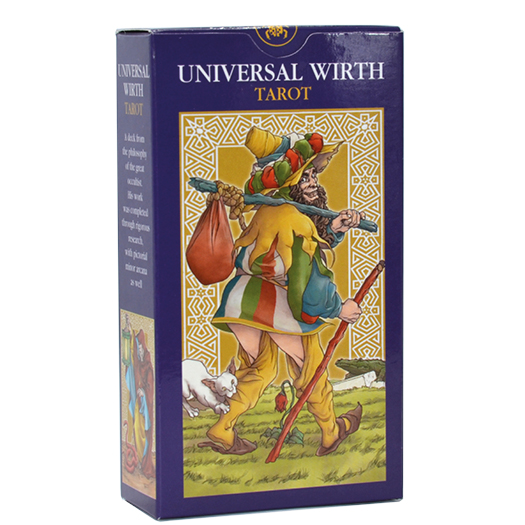
Universal Wirth Tarot - the original 22 cards expanded to 78
When Swiss occultist Oswald Wirth developed his own tarot in 1889, he limited himself to the 22 Major Arcana. For him, those were the keys to hermetic philosophy, and that was enough. The Minor Arcana were added later by Lo Scarabeo, completing the deck into a working system of 78 cards.
The result is a deck that connects two worlds. The Major Arcana remain faithful to Wirth's original imagery, with clean lines and symbolism drawn directly from nineteenth-century esoteric thought. The Minor Arcana are designed in the same style, with recognisable suit emblems and iconography that matches the French tarot traditions.
Where this deck comes from
Oswald Wirth (1860-1943) worked closely with Stanislas de Guaita, one of the central figures in the French occultist movement. He viewed the tarot as a symbolic alphabet that translates the great mysteries of existence. His cards show alchemical and astrological signs, often in combination with one another.
The colours are bright and strong. Yellow, red, blue and green dominate, usually without shadow work. The images are direct and leave little room for interpretation. Each symbol has its place and its function.
What you see on the cards
The Major Arcana follow the structure of the Marseille tradition, but the images are more refined and detailed. The High Priestess wears a tiara with three layers, the Hanged Man hangs from a living tree, the Star shows a woman pouring water onto dry ground and a pond.
The Minor Arcana are built around four suits: wands, cups, swords and pentacles. The court cards show figures in medieval dress, the pip cards combine the number of symbols with decorative patterns. The whole remains sober compared to a Rider-Waite deck, but every element has meaning.
How this deck stands apart
This is not a Rider-Waite derivative. The symbolism comes from a different tradition, one in which the card is a reference to a larger philosophical system. That makes it less intuitive for those used to scenic depictions on the Minor Arcana, but it does provide a clear foundation for those who know the hermetic keys.
The guidebook gives a brief explanation for each card, but no extended narratives. Keywords, short interpretations, that is what you get. The premise is that you make the connections yourself between the cards and the broader esoteric teaching.
Draw one card from the Major Arcana each morning for the spiritual lesson of the day, and one card from the Minor Arcana to see how that energy translates practically.
Who this deck works for
This deck is designed for those who want to learn or already know the classical esoteric tradition. The images are not meant to immediately 'speak to you', they are meant to show a system. That requires a different approach than a deck that works through feeling or projection.
For beginners it is accessible, provided you are willing to learn the symbolism as you would learn a language. For advanced readers it offers a reliable foundation to study the French tradition without modern embellishments.
About Oswald Wirth
Oswald Wirth was an artist, writer and occultist. He grew up in Switzerland and became involved in the French esoteric circles around Stanislas de Guaita and Papus. His work on tarot appeared in several books, including 'Le Tarot des imagiers du Moyen Âge' (1927), in which he set out his vision of the symbolism.
Wirth saw the tarot as a universal system that connects philosophy, religion and science. That ideal is reflected in the way he combined and positioned the symbols.
Specifications
- Number of cards: 78 (22 Major Arcana + 56 Minor Arcana)
- Card size: 66 x 120 mm
- Card backs: reversible, purple and white cross motif
- Guidebook language: English, Spanish, French, Italian, German
- Publisher: Lo Scarabeo
- Year: 2008
- ISBN: 9780738712925
- Designer of original Major Arcana: Oswald Wirth (1889)
Questions we often get
What is the difference with the original Wirth deck?
The original deck from 1889 contained only 22 Major Arcana. Lo Scarabeo added 56 Minor Arcana in the same style, making the deck complete for all spreads.
Does this deck follow Rider-Waite symbolism?
No. This deck follows the Marseille tradition and Wirth's hermetic school. The Minor Arcana show suit symbols, not scenes, as is customary in classical French tarot.