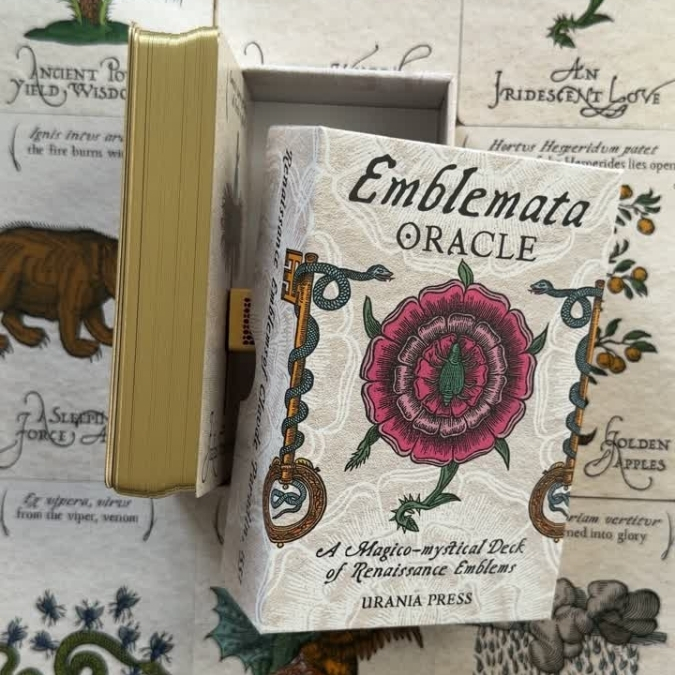
Emblemata Oracle - 16th-century woodcuts as oracle cards
Between 1500 and 1750, emblem books were the primary carriers of cultural knowledge in Europe. Nobles and merchants read them. Scholars and people who could barely read consulted them, because the images spoke across the boundary of language. Nitasia Roland of Urania Press gathered sixty of those emblems and built an oracle from them.
The source is the work of Claude Paradin, a 16th-century French historian whose emblem book Devises Heroïques was first published in 1551 in Lyon, with woodcut illustrations attributed to Bernard Salomon. Roland digitally cleaned and restored the archived museum files to recover the original line quality and contrast.
What an emblem is, and what you see on the cards
A classical emblem has three parts: an image (pictura), a motto in Latin or French (inscriptio), and a verse or moral (subscriptio). That structure appears on each card. You see black-and-white engravings of mythological scenes, animals, fabulous creatures, and alchemical imagery, alongside their original motto and a contemporary oracle title added by Roland as a distillation of the emblem's deepest meaning.
The mottos are sometimes Paradin's own words, sometimes recreated in the spirit of Renaissance wisdom. The oracle titles are Roland's. Those two layers together, the historical and the contemporary, give the deck its particular character.
How this deck works
Roland describes the emblems as catalysts: designed to draw the reader into a contemplative state of associations rather than deliver ready-made answers. Anyone accustomed to oracle cards with clear keywords and warm imagery will find something quite different here. The visual language is cryptic, the symbolism is historically dense, and meaning requires active interpretation.
That is the intention, not a limitation. The guidebook explains the structure of the emblem tradition and describes how image, motto, and verse together produce something greater than any single element. Reflective questions are part of the support offered.
Draw a card and read only the motto first. Let it sit for a day. The engraving will say something different on the second look than it did on the first.
About Nitasia Roland and Urania Press
Nitasia Roland founded Urania Press as an independent publisher of historical and esoteric card decks. In 2021 she spent a year researching hundreds of Renaissance emblems to determine which ones aligned with classical arcana archetypes. That work produced Tarot Emblemata first. The emblems that did not fit a tarot structure waited for a different vessel: this oracle.
Roland also carried out the digital restoration of the woodcuts herself, working from archived museum files and optimising contrast, line quality, and sharpness. The images are five centuries old. The print quality is not.
Specifications
- Number of cards: 60
- Language: English
- Publisher: Urania Press
- Author and designer: Nitasia Roland
- Historical source: Claude Paradin, Devises Heroïques (1551), woodcuts attributed to Bernard Salomon
- Contents: 60 oracle cards and guidebook
Questions we often get
How does this deck differ from the Tarot Emblemata by the same creator?
Tarot Emblemata follows a classical tarot structure with major and minor arcana. This oracle has no fixed hierarchy: each emblem speaks on its own terms. The historical source material is the same; the framework is different.
What language are the cards and guidebook in?
Both are in English. The original mottos on the cards are in Latin or French, as in the historical source. The oracle titles and the guidebook are in English.