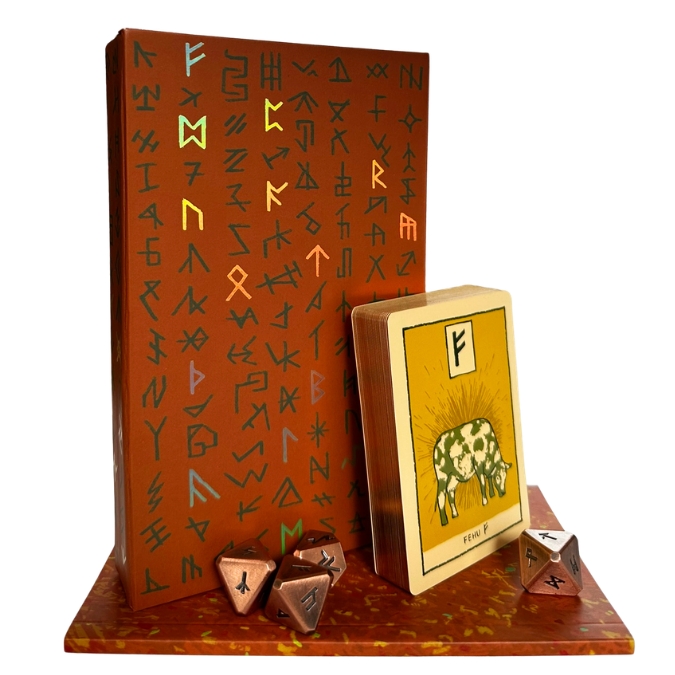
Green Glyphs Runes - rune cards with colour coding and runic dice
James R. Eads started studying runes and quickly hit a wall. The gap between an abstract Nordic symbol and its meaning was hard to cross. His solution was practical: draw an image next to each symbol that makes the meaning concrete. That is the starting point of Green Glyphs Runes.
Eads is an illustrator and artist based in Los Angeles and the founder of Prisma Visions. He made his first tarot deck in 2013 and has since expanded into nearly a dozen divination tools. Green Glyphs is his version of the runes, built from his own learning process.
What you see on the cards
Each card shows three things: the runic symbol, the traditional name, and an illustration that makes the rune's meaning visible. The style is clear and colour-coded, supporting recognition across the three rune families. Frey's Aett, Hagal's Aett, and Tyr's Aett each cover their own thematic ground, from forces of life and the gods to human qualities like loyalty, hope, and heritage.
The deck contains 33 cards. The first 24 are the classical runes of the Elder Futhark, the ancient Nordic system. The remaining 9 are Anglo-Saxon runes that came into use around the fifth century. These 9 are optional: keep them in for an expanded system or remove them if you want to work with the traditional 24 only.
The guidebook and the dice
The 65-page guidebook dedicates one page to each card. Each rune gets a short text on its origins and meaning, followed by keywords for the upright position and keywords for the reversed position. In rune tradition, that reversed position is called 'merkstave', which translates as 'dark'. Not every rune has a merkstave meaning: nine of the classical runes look the same upside down and are always read in the same way.
Alongside the cards, the set includes four runic dice. These can be used together with the cards or entirely on their own, as an alternative method for drawing runes in a reading. A drawstring pouch is not included.
About James R. Eads
James R. Eads was born in 1989 in Los Angeles. After studying printmaking, painting and graphic design in New York, he designed concert posters for bands including Phish, Dave Matthews Band and the Foo Fighters, as well as for festivals like Bonnaroo and Outside Lands. In 2013 he made his first tarot deck, and a year later opened Prisma Visions in Downtown Los Angeles.
His work carries a post-impressionistic, dream-like quality throughout. In 2016 he was among the first to paint in virtual reality using Tiltbrush, collaborating directly with Google on immersive worlds. In 2021 he co-founded Eads Bros. with his brother Sean, releasing a tarot app and currently developing a video game.
Specifications
- Number of cards: 33
- Guidebook: 65 pages
- Language: English
- Card dimensions: 64 x 89 mm
- Box dimensions: 108 x 178 mm
- Finish: Gilded edges
- Packaging: Orange storage box
- Included: 4 runic dice
- Publisher: Prisma Visions
- Author and illustrator: James R. Eads
Questions we often get
What is the difference between the 24 classical runes and the 9 extra Anglo-Saxon runes?
The 24 classical runes, known as the Elder Futhark, form the traditional Nordic runic system that has been in use for millennia. The 9 Anglo-Saxon runes came into practice later, around the fifth century, and introduce additional concepts. Both are included in this deck, but you can remove the 9 extra cards if you prefer to work with the classical system only.
What are the runic dice used for?
The four dice are marked with runic symbols and offer an alternative to drawing cards. You can use them alongside the cards or entirely separately. A drawstring pouch is not included with the set.
Ook interessant:
Runes of Light Oracle, Rune Oracle en Rune Magic Oracle Deck.