Gustave Doré Tarot - nineteenth-century woodcuts as tarot
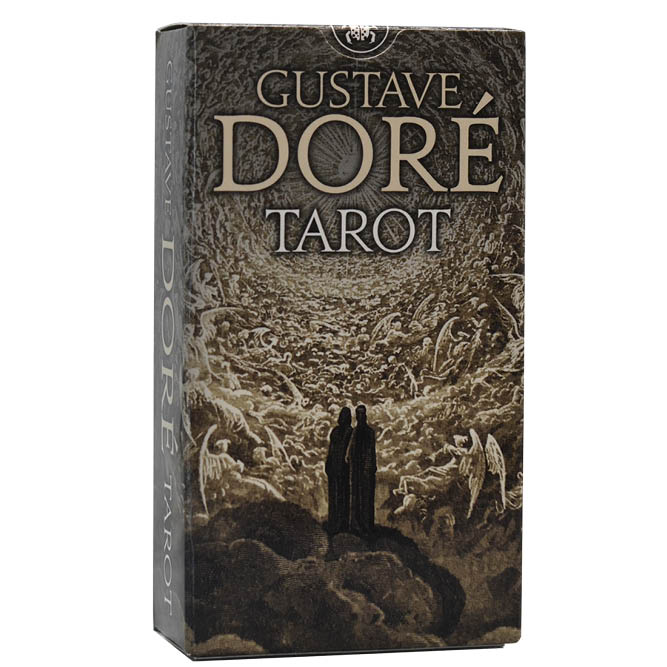
Not many tarot decks can say they were created by someone who never saw a tarot card. Gustave Doré (1832-1883) drew and engraved biblical and literary scenes for editions of Dante, the Bible and Milton. Pietro Alligo selected those images and mapped them to the tarot arcana.
The result is a deck that asks you to look more than read. Every image is a woodcut engraving: black and white, full of shadow, full of detail. The drama lies in the compositions, the faces, the balance between light and dark.
What you see on the cards
The cards are executed in the style that made Doré famous: romantic, monumental, sometimes overwhelming. Angels fall, souls are redeemed, figures stand before mountainous landscapes or at the edge of an abyss.
Without colour, the symbolism lands differently. You read facial expressions, body language and the relationship between figure and space. It asks for more attention than a coloured deck, but gives more back when you take that time.
The cards measure 70 x 120 mm, standard tarot size. They are printed on sturdy cardstock with a matte finish that shuffles well.
How you work with them
This is not a deck for quick answers. The images are too layered, too dense. It asks for quiet, for a moment when you can concentrate on what is happening in the image.
Many readers use this deck for shadow work or for questions where nuance matters more than clarity. The biblical scenes add extra weight to themes like morality, redemption, trial and grace.
When laying out the cards, watch where the light falls in the engraving. Where is light, where is shadow? That often tells more than the figure itself.
About Gustave Doré and Pietro Alligo
Gustave Doré was a French illustrator who became famous for his work on literary classics. His engravings for Dante's Inferno are among the most recognized religious art of the nineteenth century. He worked quickly, obsessively and with an enormous sense of composition.
Pietro Alligo is the curator who selected the images and mapped them to the tarot system. He did so without altering the original engravings, which means some pairings are symbolic rather than literal.
Specifications
- Number of cards: 78 (22 Major Arcana, 56 Minor Arcana)
- Card size: 70 x 120 mm
- Language: multilingual, including English
- Publisher: Lo Scarabeo
- ISBN: 9780738773049
- Weight: 350 g
- Material: sturdy cardstock with matte finish
- Guidebook: brief instruction booklet with core meanings
- Artist: Gustave Doré
- Curator: Pietro Alligo
Questions we often get
Are the cards difficult to read without colour?
That depends on how you are used to looking. If you normally rely heavily on colour in your readings, this deck asks for a different approach. You read body language, composition and emotion instead of colour energy.
Do the cards have keywords or titles on them?
Yes, each card has a title and in some cases a short indication. The guidebook gives a brief description of the core meaning for each card.