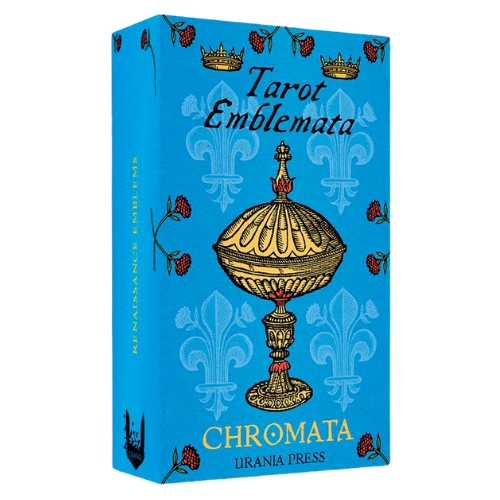
Tarot Emblemata CHROMATA - 470-year-old woodcuts as a tarot deck
Most tarot cards start on a blank sheet of paper. These started in 1551 as woodcuts in a French emblem book. Claude Paradin published his Devises Heroïques that year, a collection of images with short moral mottoes in Latin and French.
Urania Press restored those engravings, added colour and turned them into a complete tarot deck. The structure follows the Rider-Waite-Smith system, but the images come from the Renaissance. The result is a deck where you read sixteenth-century symbolism with a familiar tarot logic.
What you see on the cards
Each card shows a restored woodcut on a dark brown background, with gold metallic ink for details and text. The colours are added, not original. That gives the images a vivid quality the old engravings did not have.
Below each image is a Latin motto, sometimes supplemented with French. Those mottoes were not invented for tarot, but as moral lessons for Renaissance readers. In this deck they work as additional intuitive anchors.
Alongside the 78 standard tarot cards, the deck contains 10 additional oracle cards. These stand apart from the major and minor arcana and can be used separately or mixed with the rest.
The guidebook and how you work with it
The guidebook runs to 184 pages and explains both the tarot meanings and the original emblematic context. That is useful, because without explanation many images are not immediately clear.
The deck follows the Rider-Waite-Smith structure, which means the numbering and themes are recognizable if you know that system. The images themselves are different, sometimes more abstract, sometimes more direct than you might be used to. That takes a little adjustment.
Draw one of the 10 additional oracle cards and read the Latin motto aloud. Let that sentence sit for a day or two before you look up the explanation. Sometimes the sound says more than the translation.
Material and finish
The cards are printed on 350 gsm cardstock with a linen finish. They feel sturdy and shuffle smoothly. The size is 69.85 × 120.65 mm, slightly narrower than a standard tarot card but not awkward.
The packaging is a matte tuck box with embossing and gold foil. The guidebook is softcover, richly illustrated with images of all the cards.
About Claude Paradin and Urania Press
Claude Paradin was a sixteenth-century French writer and canon whose emblem book had a major influence on European visual culture. His work combined classical mythology with Christian morality.
Urania Press digitally restored the engravings and adapted them for this tarot deck. The colour choices and adjustments are theirs, not from Paradin's time.
Specifications
- Number of cards: 88 (78 tarot cards + 10 oracle cards)
- Card size: 69.85 × 120.65 mm
- Cardstock weight: 350 gsm
- Finish: linen finish, gold metallic ink on dark brown background
- Guidebook: 184 pages, softcover, fully illustrated
- Language: English (cards and guidebook)
- Packaging: matte tuck box with embossing and gold foil
- Publisher: Urania Press
- Based on: Devises Heroïques by Claude Paradin (1551)
Questions we often get
How does this deck differ from the standard Tarot Emblemata?
This Chromata edition is fully coloured. Other versions show the original black-and-white woodcuts. The colour adds an extra layer of emotion and clarity, but does not change the structure or symbolism.
Are the Latin mottoes translated in the guidebook?
Yes. The guidebook gives both the original text and an English translation, and explains the emblematic meaning in relation to the tarot interpretation.