Golden Tarot of the Renaissance - reconstruction of the 15th-century Charles VI Tarot
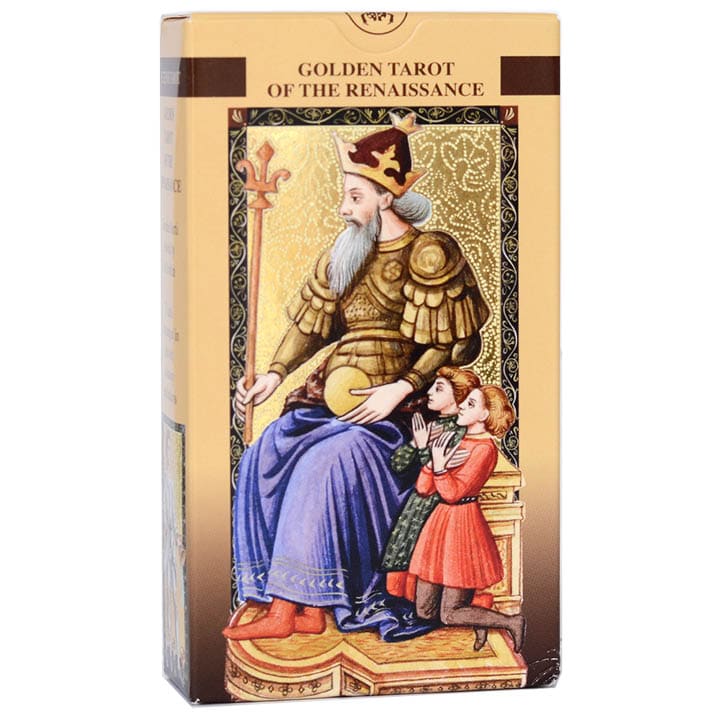
This is not a modern interpretation of Renaissance art. This is a restoration of one of the oldest tarot decks in the world. The Golden Tarot of the Renaissance, also known as the Charles VI Tarot or Gringonneur Tarot, originates from 15th-century Ferrara and was created for the Este family.
Artist A.A. Atanassov studied the surviving cards and filled in the missing ones based on frescoes from the Schifanoia Palace. The Major Arcana are reconstructions of the originals. The Minor Arcana, of which no historical examples are known, are based on the same visual language: astrological decans, months of the year, courtly scenes. Every card is finished with gold foil.
What you see on the cards
The imagery is medieval and aristocratic. Figures wear long robes, hold staves and swords as if they were sceptres, and stand in poses you would also find in religious panels. The colours are clear but not bright: red, blue, green, gold.
The gold foil sits on crowns, halos, backgrounds and details in clothing. It is not a subtle accent. Under light it catches your eye immediately.
The Major Arcana follow the classic order and symbolism, but the execution differs from what you might be used to if you know a Rider-Waite-Smith deck. The Fool wears a turban. The Hermit holds an hourglass. The Moon shows two astrologers studying the sky. The symbolism is older, more direct, less psychological.
Who this works for
This deck follows the classic tarot structure. You can work with it as you would with any other tarot deck. What is different is the imagery. If you are used to modern tarot with action and emotion on the Minor Arcana, you will need to shift here. The figures often stand still, and meaning lies more in posture, colour and attribute than in an unfolding narrative.
The gold foil also makes this deck suitable for ritual or meditative use. The light that reflects off it draws attention and holds it.
Lay the cards out under a lamp or in daylight. The gold foil catches light differently depending on the angle, and that can draw your eye to a detail you might otherwise miss.
About A.A. Atanassov
Atanassov restores historical tarot cards. His approach is based on art historical research: he studies the original cards, analyses the style, and fills in missing parts in a way that fits what was there. For this deck he immersed himself in the Renaissance art of Ferrara and the iconography of the Schifanoia Palace.
Specifications
- Number of cards: 78
- Card size: 70 x 120 mm
- Guidebook language: multilingual (English, Spanish, French, Italian, German)
- Publisher: Lo Scarabeo
- Finish: gold foil accents on all cards
- Cardstock quality: sturdy, high-quality cardstock
- Artist: A.A. Atanassov
- Style: based on 15th-century tarot cards from Ferrara and frescoes from the Schifanoia Palace
Questions we often get
Does the symbolism differ from a Rider-Waite-Smith?
Yes. The Major Arcana follow the same order and basic meanings, but the imagery is older and more rooted in medieval iconography. The Minor Arcana are not scenes but standing figures with attributes, based on astrological decans and months of the year.
Will the gold foil wear off with use?
Lo Scarabeo uses modern printing techniques. The gold foil is firmly applied and withstands normal use. Shuffle carefully and you will keep the shine for years.