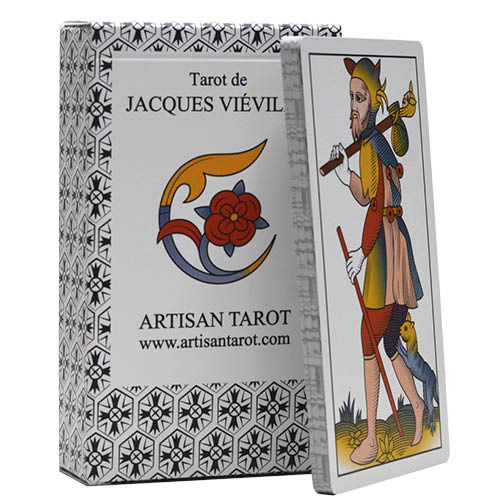
Jacques Vieville Tarot Deck - early French tarot from 1650 with divergent symbolism
Anyone who has handled a historical tarot deck knows how they feel: angular, rough, not always easy to shuffle. This deck goes a step further. It is a reproduction of cards made around 1650 in Paris by master cardmaker Jacques Vieville, at a time when tarot imagery was still forming.
The images diverge noticeably from what would later become the norm. The Tower is a tree here. The Hanged Man stands upright. For anyone used to classic Marseille decks, this is unfamiliar territory, and that is precisely what makes it interesting.
What you see on the cards
The woodcuts have been carefully restored to preserve the original colours and lines. They are simple prints, as you would expect from the 17th century: yellow, red and blue areas on white, with black outlines. The execution is less refined than later decks, but more direct because of it.
The symbolism is Pre-Marseille. That means the deck follows its own Parisian line, before the Marseille tradition became the standard in France. The numbering does not always match what you know. Neither do the images. That makes it difficult for beginners, but valuable for those who want to trace the evolution of tarot imagery.
Who this works for
This is not a deck to start with. It requires basic knowledge of tarot structure and the willingness to let go of fixed associations. The divergent symbolism forces you to look at the cards anew, without the standard meanings you find in most guidebooks.
Many people use the deck alongside a classic Marseille, to see where the traditions diverge. That sometimes gives new angles on cards you have been reading for years.
Place a card from the Vieville deck next to the same card from a Marseille deck. The differences show how symbols have shifted and changed over three hundred years.
About Jacques Vieville
Jacques Vieville was a master cardmaker active in Paris between 1643 and 1664. His work is studied by historians because it forms a crucial link in the early card culture of France. Many details about his life have not survived, but the cards themselves remain a testament to his craft.
Specifications
- Number of cards: 78 (Major and Minor Arcana)
- Card size: 80 x 120 mm
- Language: French (cards and accompanying booklet)
- Publisher: Héron
- Execution: reproduction of 17th-century woodcuts
- Contents: 78 cards with historical booklet
Questions we often get
Can I use this deck for reading, or is it only a collector's item?
You can read with it, but it takes getting used to. The divergent symbolism means that fixed meanings do not always apply. Experienced readers often use it for reflection or alongside another deck.
How does this deck differ from the Tarot de Marseille?
The numbering sometimes diverges, and several major arcana cards show different images. The Tower is a tree, the Hanged Man stands upright. The deck follows an older, Parisian line that existed independently of the later Marseille standard.