A.E. Waite Standard Deluxe PO - the Rider-Waite deck in Portuguese pocket format
Few tarot cards have shaped how people read tarot today as much as this one. This is the deck that in 1909 first gave all 78 cards a complete scene. That made intuitive reading possible, without needing to memorize all the meanings.
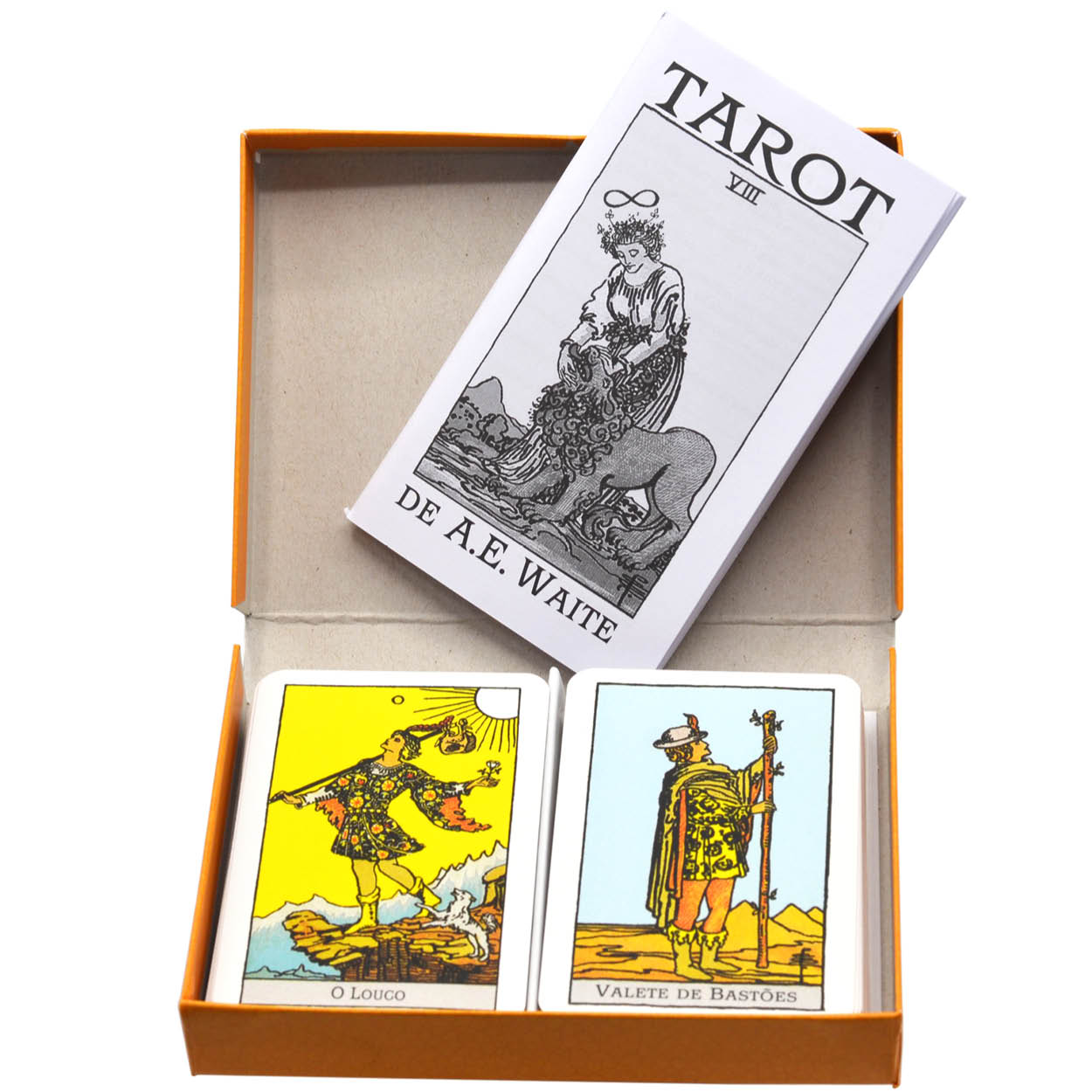
This Portuguese pocket edition is published by AGM Urania, a publisher that carefully reproduces the original colours and details. The cards are small enough to carry with you, but retain the clarity of Pamela Colman Smith's illustrations.
What you see on the cards
All 78 cards have a full scene. Where older decks showed only the number of wands, swords, cups or pentacles for the minor arcana, Pamela Colman Smith drew situations with people. Those images tell stories you can read without a list of meanings.
The colours are true to the first edition: muted shades of yellow, grey, blue and green. The back has the classic brown pattern with white, also known as the pebble back. It is the same pattern as on the very first edition.
The cards are printed on sturdy cardstock that shuffles well. The format is 57 x 89 mm, compact enough to fit in a coat pocket or small bag.
The guidebook and how to work with it
The deck comes with a 96-page guidebook in Portuguese, written by Rachel Pollack and Johannes Fiebig. Pollack wrote one of the most respected books on tarot, 'Seventy-Eight Degrees of Wisdom'. Fiebig is a German tarot author who focuses on practical applications.
The texts in the guidebook go deeper than standard card meanings. You get context about the symbolism and background to the choices Waite and Smith made. This helps especially if you want to understand why certain elements appear on a card.
The pocket format makes this deck suitable for daily use while travelling. The sturdy storage box protects the cards well enough to carry them loose in a bag.
Draw a card in the morning and keep it in your wallet or inside pocket all day. Look at the image occasionally and notice which details keep catching your attention.
About Arthur Edward Waite and Pamela Colman Smith
Arthur Edward Waite was a member of the Hermetic Order of the Golden Dawn, an esoteric order active in England in the late nineteenth century. He designed the symbolic structure of the deck and determined which elements should appear on each card.
Pamela Colman Smith drew all the cards. She was a British-American artist who previously made theatre sets and magazine illustrations. Her strength lay in translating abstract symbols into human stories. She received a one-time payment for her work at the time and never earned anything from sales.
The collaboration between Waite and Smith resulted in a deck that became the basis for almost all modern tarot cards. Most decks you see now are either based on this system, or deliberately different because they want to push against it.
Specifications
- Number of cards: 78
- Card size: 57 x 89 mm (pocket size)
- Language: Portuguese (cards and guidebook)
- Guidebook: 96 pages
- Guidebook authors: Rachel Pollack and Johannes Fiebig
- Publisher: AGM Urania
- Finish: Classic brown pebble back
- Packaging: Sturdy storage box
- Designer: Arthur Edward Waite
- Illustrator: Pamela Colman Smith
Questions we often get
Is this suitable for beginners?
Yes, this is the standard deck on which most tarot teaching is based. The full scenes on all cards make it easier to remember meanings. The guidebook gives enough context to get started, provided you understand Portuguese.
How does this differ from other Rider-Waite editions?
This is a pocket edition in Portuguese. The cards are smaller than standard size and the texts are fully translated. AGM Urania adheres to the original colours and classic back design, which not all publishers do.