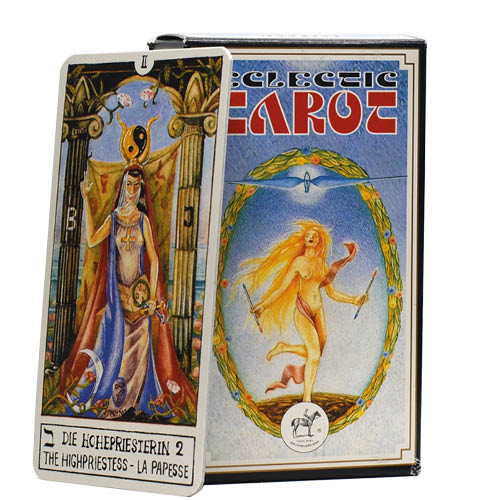
Eclectic Tarot
€ 20,50
€ 60,00
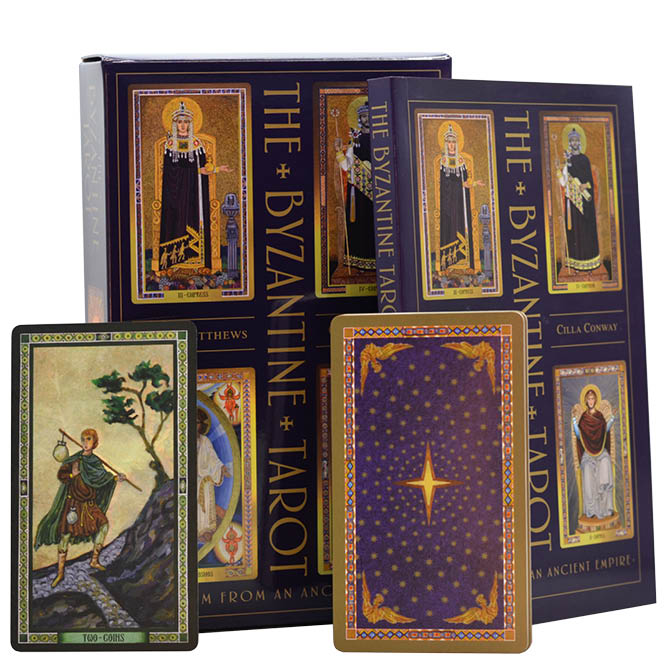
The Byzantine Tarot draws directly from the iconographic art of the Eastern Roman Empire. Cilla Conway painted 78 cards in the style of Byzantine mosaics and icons, dominated by gold, deep ruby red and royal blue. The structure follows the Rider-Waite-Smith tradition, but the archetypes are translated into Byzantine figures and titles. John Matthews wrote the accompanying 160-page guidebook.
A tarot set that reads like a historical artefact, yet remains accessible to anyone familiar with the RWS tradition.
Only 3 left in stock
Many tarot decks work quietly in the background of a daily routine. This one asks for a different kind of attention. The Byzantine Tarot carries the atmosphere of gilded domes, solemn frescoes and ancient church interiors. You pick up a card and it looks back at you with the stillness of an icon from Ravenna.
The cards were painted by Cilla Conway, a Dutch-British artist trained as a portrait painter, working alongside tarot writer John Matthews. Conway created all the artwork. Matthews wrote the 160-page guidebook, which covers both the history of the Byzantine Empire and its connection to tarot symbolism.
The imagery is formal and ceremonial. Figures face the viewer directly, as is traditional in Byzantine iconography. Backgrounds shimmer in printed gold, without real gold foil. Deep ruby red and royal blue dominate alongside the gold tones.
Conway followed historical iconography more closely here than in her other decks. The Hierophant becomes a patriarch of the Orthodox Church. The Emperor carries the title Basileus, the Empress that of Basilissa. English titles appear inside frames that echo the inscriptions found on old icons.
The structure stays true to the Rider-Waite-Smith system, with the four suits of Wands, Cups, Swords and Coins. Anyone familiar with RWS symbolism will recognise the archetypes, even in their very different form.
Reviewers describe the cards as heavy, wise and historical in character. Questions around ethics, authority, tradition and spiritual discipline come through with particular clarity in readings with this deck. That matches the visual language: stately, but not cold.
That last quality is typical of Conway's work. Despite the ceremonial forms, each card carries a warmth you would not necessarily expect. Conway trained as a portrait painter, and that shows in the expressiveness of the faces, even when they appear still and frontal.
Hold the cards under a lamp or in natural light. The printed gold effect behaves differently as the light shifts, and gives the illustrations a depth that does not come through on a screen.
Cilla Conway worked for years as a professional portrait painter before creating tarot decks. She is known for an intuitive approach, often painting without a fixed plan and allowing images to emerge from the subconscious. For The Byzantine Tarot she worked within a stricter framework, shaped by the demands of historical iconography.
Her other well-known decks include The Devas of Creation Tarot, The Intuitive Tarot and The Old Gods Tarot. John Matthews is a recognised figure in the tarot world as author and researcher. Together they bring visual depth and textual grounding to the same set.
Do I need to know the RWS tradition to work with this deck?
The Byzantine Tarot follows the Rider-Waite-Smith structure in full, with 22 Major Arcana and 56 Minor Arcana across four suits. Anyone who knows RWS symbolism will recognise the layout. Matthews' guidebook also explains the historical background behind each Byzantine image, so you can work with both layers.
Is there real gold on the cards?
No. The gold is printed, not applied as foil. It does produce a visible sheen that catches different light conditions. The cards are noted for their vivid, well-reproduced colour throughout.
| Author | Cilla Conway |
| Language | English |
| Publisher | Self-Published Decks |
| ISBN | 9780764360411 |
| SKU | 2016-CC04 |
Since 1999, Tarot.nl has been the trusted source for the largest collection of cards in the Benelux. As a Dutch family business, we personally select every deck based on quality and character.

Dive into the world of Tarot.nl by subscribing to our engaging newsletter.
This site uses tracking technologies. You may opt in or opt out of the use of these technologies.